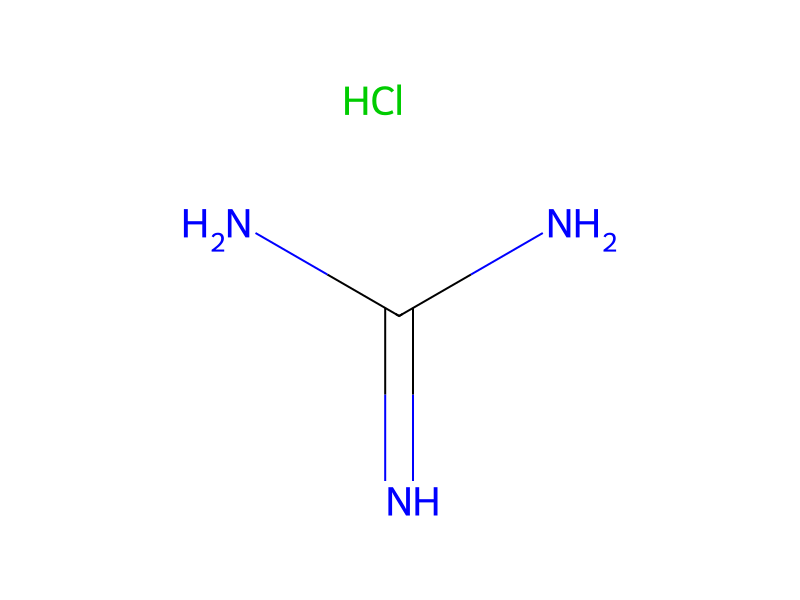
Guanidine Hydrochloride → N-carbamimidoyl-4-chloro-3-sulfamoylbenzamide;hydrochloride
Reaction equation

Cl.[NH2:2][C:3]([NH2:5])=[NH:4].[Cl:6][C:7]1[CH:16]=[CH:15][C:10]([C:11](OC)=[O:12])=[CH:9][C:8]=1[S:17](=[O:20])(=[O:19])[NH2:18].C[O-].[Na+].[Na]>CO>[ClH:6].[Cl:6][C:7]1[CH:16]=[CH:15][C:10]([C:11]([NH:4][C:3]([NH2:5])=[NH:2])=[O:12])=[CH:9][C:8]=1[S:17](=[O:19])(=[O:20])[NH2:18]Participants
6





Procedure
8.5 g of guanidine hydrochloride and then 5 g of methyl 4-chloro-3-sulfamoylbenzoate are added to a methanolic sodium methoxide solution, prepared from 1.9 g of sodium in 90 ml of methanol. After heating this mixture to 50°-60° C. under inert gas (nitrogen or argon) over the course of 30 hours, the solvent is removed by distillation, the solution is adjusted to pH 6 after taking up the residue with 2 N acetic acid and is extracted with ethyl acetate. After acidifying the dried extract (drying over magnesium sulfate) using ethereal hydrochloric acid, the title compound is filtered off.
Workup
- temperatureAfter heating this mixture to 50°-60° C. under inert gas (nitrogen or argon) over the course of 30 hours
- customthe solvent is removed by distillation
- extractionis extracted with ethyl acetate
- extractionextract
- dry with material(drying over magnesium sulfate)
- filtrationthe title compound is filtered off
Sources & evidence
- ORD record
- ord-7fb21506da7d4ad1903979f383b80a74
- Source dataset
- uspto-grants-1992_02
- Patent number
- US05091394
Reaction notes
Loading…