Diisopropylethylamine → Encenicline enantiomer
Reaction equation

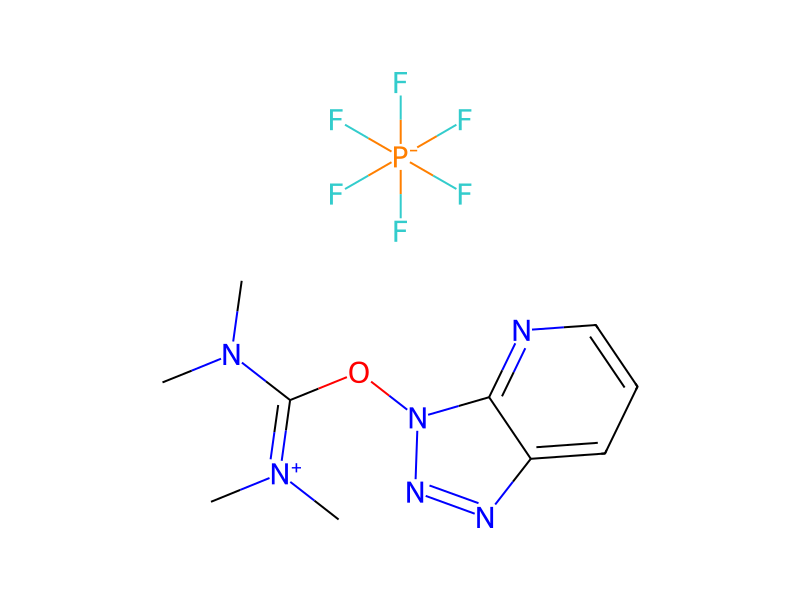
[Cl:1][C:2]1[C:10]2[S:9][C:8]([C:11]([OH:13])=O)=[CH:7][C:6]=2[CH:5]=[CH:4][CH:3]=1.CN(C(ON1N=[N:29][C:24]2[CH:25]=[CH:26][CH:27]=[N:28][C:23]1=2)=[N+](C)C)C.F[P-](F)(F)(F)(F)F.[CH:38](N(CC)C(C)C)(C)[CH3:39]>CN(C=O)C>[ClH:1].[N:28]12[CH2:27][CH2:26][CH:25]([CH2:38][CH2:39]1)[C@H:24]([NH:29][C:11]([C:8]1[S:9][C:10]3[C:2]([Cl:1])=[CH:3][CH:4]=[CH:5][C:6]=3[CH:7]=1)=[O:13])[CH2:23]2Participants
5
Reactant 3


Product 1

Reagents, catalysts & solvents 1

Procedure
176.2 mg (0.83 mmol) of 7-chloro-1-benzothiophene-2-carboxylic acid, 150 mg (0.75 mmol) of S-3-aminoquinuclidine dihydrochloride, 343.7 mg (0.90 mmol) of HATU, 350.5 mg (2.71 mmol) of N,N-diisopropylethylamine and 3.0 ml of DMF are reacted according to the general procedure (variant B). The reaction mixture is purified by preparative HPLC. The product is dissolved in a mixture of 4M HCl in dioxane and methanol and then concentrated. 231.9 mg (85.7% of theory) of the title compound are obtained. The analytical data correspond to those of the enantiomeric compound from example 69.
Workup
- customThe reaction mixture is purified by preparative HPLC
- dissolutionThe product is dissolved in a mixture of 4M HCl in dioxane and methanol
- concentrationconcentrated
Sources & evidence
- ORD record
- ord-5ad3a80420d04cf4893520c871231748
- Source dataset
- uspto-grants-2010_06
- Patent number
- US07732477B2
Reaction notes
Loading…