Calcium Carbonate → 10031-31-9
Reaction equation

[IH:1].C(=O)([O-])[O-:3].[Ca+2:6].[Ca]>[Pt]>[OH2:3].[OH2:3].[OH2:3].[OH2:3].[OH2:3].[OH2:3].[I-:1].[Ca+2:6].[I-:1]Participants
Reactant 3
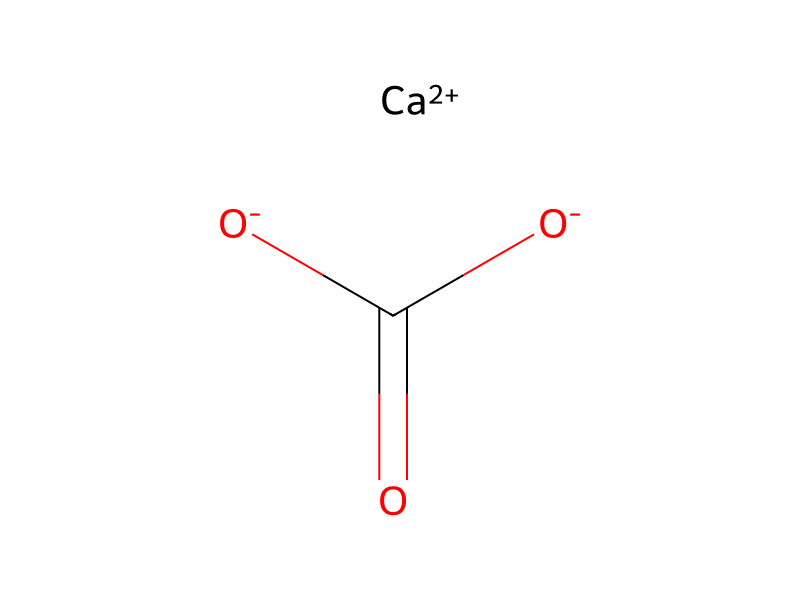


Product 1

Reagents, catalysts & solvents 1

Conditions
- Temperature
- 5 °C
Procedure
In a suitable vessel of glass, stainless steel, or platinum, hydriodic acid (47 percent solution) 790 parts is added to calcium carbonate (215 parts) stoichiometrically in excess of the calcium, boiled to remove CO2, and made alkaline with calcium oxide. The resulting reaction mass in the form of a slurry is filtered for insolubles and made acid with additional 47 percent aqueous hydrogen iodide to a pH below 1. The filtrate is boiled to concentrate the solution through a continually rising boiling range to 146° C. The resulting highly concentrated liquor was cooled to 5° C. to form calcium iodide hexahydrate in crystalline form. The mother liquor is poured off and the crystals are spread loosely in an inert tray of quartz or a resinous material, such as polytetrafluoroethylene, to a depth of approximately 1 inch. The filled tray is then placed in a vacuum drying oven equipped with a vapor trap cooled with dry ice. The oven is then evacuated and pumping continued over a period of 24 to 48 hours, with no heat applied, until a pressure of 0.1 mm. Hg absolute or less is attained. The calcium iodide is then heated slowly to about 75° to 80° C. over an interval of 40 to 60 hours, and held at this temperature for approximately 24 hours, or until a pressure of about 0.1 to 0.03 mm. Hg absolute is attained as measured by a Pirani-type vacuum gauge.
Workup
- customto remove CO2
- customThe resulting reaction mass in the form of a slurry
- filtrationis filtered for insolubles
- concentrationto concentrate the solution through
- customto 146° C
Sources & evidence
- ORD record
- ord-27cc3fcdbeea4ff38d38f89136d77ded
- Source dataset
- uspto-grants-1976_09
- Patent number
- US03981818
Reaction notes
Loading…