Itaconic acid → Itaconic acid
Reaction equation

[C:1]([OH:6])(=[O:5])[C:2]([CH3:4])=[CH2:3].[C:7]([OH:12])(=[O:11])C(C)=C.C(O)(=O)C(C)=C.C(C(CO)(CO)CC)O.C(OCC(COC(=O)C=C)(COC(=O)C=C)COC(=O)C=C)(=O)C=C.C(OCC(COC(=O)C(C)=C)(COC(=O)C(C)=C)COC(=O)C(C)=C)(=O)C(C)=C.C(N)(=O)C=C.C(N)(=O)C(C)=C.C(N)(=O)C=C.CC(C)=O.CC(C)=O.C(N)(=O)C(C)=C.CC(C)=O.CC(C)=O.C(O)C=C.C(OCC=C)(=O)C1C(=CC=CC=1)C(OCC=C)=O.C(O)(=O)/C=C/C(O)=O.C(O)(=O)C(CC(O)=O)=C>>[C:7]([OH:12])(=[O:11])/[CH:3]=[CH:2]\[C:1]([OH:6])=[O:5].[C:7]([OH:12])(=[O:11])/[CH:3]=[CH:2]/[C:1]([OH:6])=[O:5].[C:1]([OH:6])(=[O:5])[C:2]([CH2:4][C:7]([OH:12])=[O:11])=[CH2:3]Participants
Reactant 11
 HCID 811Itaconic acid
 HCID 6579Acrylamide2×
 HCID 6595Methacrylamide2×
 HCID 7858Allyl Alcohol
 HCID 8560Diallyl phthalate
 HCID 62556Pentaerythritol tetraacrylate
 HCID 76740Pentaerythritol tetramethacrylate
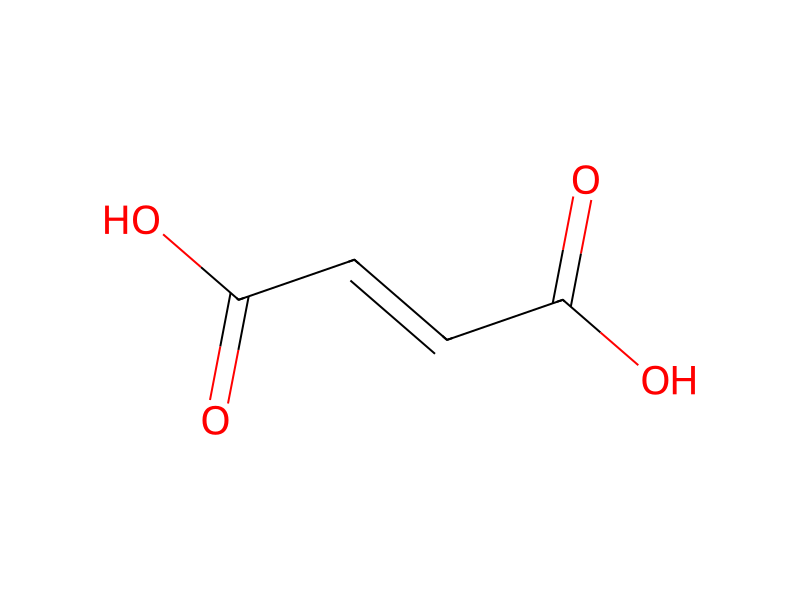 HCID 444972Fumaric Acid
 HCID 183204492-Ethyl-2-(hydroxymethyl)propane-1,3-diol;2-methylprop-2-enoic acid
 HCID 215849214-Acrylamido-4-methyl-2-pentanone
 HCID 21915793Diacetone methacrylamide
Product 3

Procedure
The term "addition-polymerizable unsaturated compound" as used herein is intended to indicate compounds having at least one carbon-carbon double bond capable of taking an active part in the addition polymerization reaction. Examples of such compounds include those having at least one group selected from a vinyl group, a vinylidene group, a fumaroyl group and a maleoyl group. Specific examples of such compounds include unsaturated monocarboxylic acids such as acrylic acid and methacrylic acid; esters of acrylic acid or methacrylic acid having as an ester-forming group an alkyl group, a cycloalkyl group, a halogenated alkyl group, an alkoxyalkyl group, a hydroxyalkyl group, an aminoalkyl group, a tetrahydrofurfuryl group, an allyl group, a glycidyl group, a benzyl group or a phenoxy group; mono- or di-acrylates and mono- or di-methacrylates of alkylene glycols or polyoxyalkylene glycols (number average molecular weight: up to 2,000); polyacrylates and polymethacrylates such as trimethylopropane triacrylate, trimethylolpropane trimethacrylate, pentaerythritol tetraacrylate and pentaerythritol tetramethacrylate; unsaturated monocarboxylic acid amides such as acrylamide and methacrylamide; derivatives of acrylamide or methacrylamide such as N-alkyl- or N,N-dialkyl-acrylamides, N-alkyl- or N,N-dialkyl-methacrylamides, N-hydroxyalkyl- or N,N-dihydroxyalkyl-acrylamide, N-hydroxyalkyl- or N,N-dihyroxyalkyl-methacrylamides, diacetone acrylamide, diacetone methacrylamide, N,N'-alkylenebisacrylamide and N,N'-alkylenebismethacrylamide; allyl compounds such as allyl alcohol, allyl isocianate, diallyl phthalate and triallyl cyanurate; unsaturated dicarboxylic acids and acid anhydrides such as maleic acid, maleic anhydride, fumaric acid and itaconic acid; monoesters and diesters of maleic acid, fumaric acid or itaconic acid having as an ester-forming group one or two groups selected from an alkyl group, a halogenated alkyl group and an alkoxy-alkyl group; acrylates and methacrylates of epoxy group-containing compounds obtained by esterifying acrylic acid or methacrylic acid with an epoxy group-containing compound which is obtained, for example, by the dehydrochlorination reaction of a polyhydric alcohol or a polyhydric phenol with epichlorohydrin; and other unsaturated compounds such as styrene, vinyltoluene, divinylbenzene, N-vinylcarbazole, and N-vinylpyrrolidone. Various resins and polymers may also be used as the addition-polymerizable unsaturated compound. Examples of such resins and polymers include unsaturated polyesters prepared from at least one unsaturated dicarboxylic acid, such as maleic acid, fumaric acid or itaconic acid, and/or its anhydride, and at least one polyhydric alcohol such as ethylene glycol, propylene glycol, diethylene glycol, triethylene glycol, glycerin, trimethylolpropane or penta-erythritol; unsaturated polyesters prepared from at least one unsaturated dicarboxylic acid or its anhydride as mentioned above, at least one polyhydric alcohol as mentioned above, and at least one saturated dicarboxylic acid or its anhydride such as succinic acid, adipic acid, phthalic acid, isophthalic acid, phthalic anhydride, trimellitic acid or trimellitic acid anhydride; alkyd resins prepared by using at least one drying oil and/or at least one semidrying oil as a modifier for polyesters; unsaturated polyurethanes having addition-polymerizable unsaturated groups derived from at least one unsaturated mono- or di-carboxylic acid or its ester derivative or an unsaturated polyester as mentioned above and introduced thereinto by utilizing terminal isocyanate and/or hydroxyl groups of a urethane compound or polyurethane having urethane groups derived from at least one polyol having two or more hydroxyl groups and at least one polyisocyanate, for example, unsaturated polyurethanes which are prepared from (1) a polyurethane having terminal isocyanate and/or hydroxyl groups and prepared from at least one polyol such as a polyhydric alcohol as mentioned above, a polyester polyol or a polyether polyol and at least one polyisocyanate such as tolylene diisocyanate, diphenylmethane-4,4'-diisocyanate or hexamethylene diisocyanate and (2) at least one unsaturated mono- or di-carboxylic acid as mentioned above or its ester or polyester having active hydrogen atoms derived from hydroxyl (reactive with the terminal isocyanate) and/or carboxyl (reactive with both of the terminal isocyanate and the terminal hydroxyl) and/or amino groups (reactive with the terminal isocyanate), if any; polyisocyanate-modified unsaturated polyester obtained by linking two or more molecules of an unsaturated polyester as mentioned above with a polyisocyanate; polymers having, in its side chains, carbon-carbon double bonds capable of taking an active part in the addition polymerization reaction, for example, polymers obtained by reacting an unsaturated carboxylic acid or its anhydride with a polymer having hydroxyl groups such as polyvinyl alcohol or cellulose, polymers obtained by esterifying a polymer or a copolymer of acrylic acid or methacrylic acid having carboxyl groups with an unsaturated alcohol such as allyl alcohol, glycidyl acrylate or glycidyl methacrylate, a polymer obtained by reacting a copolymer containing maleic anhydride monomer units with allyl alcohol, a hydroxyalkyl acrylate and/or a hydroxy-alkyl methacrylate, and a polymers obtained by reacting a copolymer having glycidyl acrylate and/or glycidyl methacrylate monomer units with acrylic acid and/or methacrylic acid. Various oligomers may also be used as the addition-polymerizable unsaturated compound. Examples of such oligomers include oligomers of an ester-acrylate type obtained by the co-condensation of an esterification reaction system composed of a polycarboxylic acid or its anhydride and a polyhydric alcohol with acrylic acid and/or methacrylic acid and having a number average molecular weight of about 200 to about 5,000, said molecular weight being controlled by choosing an appropriate molar ratio of the raw materials, examples of said polycarboxylic acid or its anhydride being adipic acid, isophthalic acid, phthalic acid and phthalic anhydride, examples of said polyhydric alcohol being ethylene glycol, propylene glycol, diethylene glycol, triethylene glycol, glycerin, trimethylolpropane and pentaerythritol. The above-enumerated addition-polymerizable unsaturated compounds may be used either alone or in combination. In the addition-polymerizable unsaturated compounds, by the alkyl is meant a straight chain or branched aliphatic hydrocarbon group having 1 to 20 carbon atoms, by the cycloalkyl a group having 5 to 26 carbon atoms and consisting of a 5- or 6-membered alicyclic ring unsubstituted or substituted with alkyl, and by the alkylene a straight or branched hydrocarbon group having 2 to 6 carbon atoms. The number average molecular weight of a resin or polymer is desired to be up to 1,000,000, preferably 1,000 to 200,000. For the measurement of a number average molecular weight, there is adopted a gel permeation chromatography (GPC) method using, as a standard sample, a polystyrene manufactured by Pressure Chemical Co., U.S.A. and as an apparatus, WATERS 200 manufactured by Japan-Waters Co., Japan.
Sources & evidence
- ORD record
- ord-d3cdcc73c6a44d71a7d1485665930213
- Source dataset
- uspto-grants-1981_09
- Patent number
- US04287290
Reaction notes
Loading…