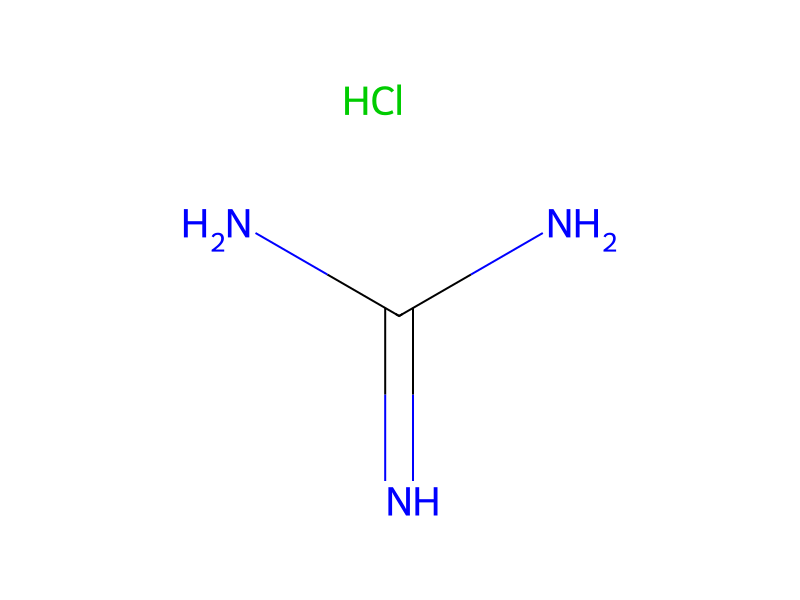
Guanidine Hydrochloride → 2-(2-AMINOPYRIMIDIN-4-YL)PHENOL
Reaction equation

[Na].C[O-].[Na+].Cl.[NH2:6][C:7]([NH2:9])=[NH:8].CN(C)[CH:12]=[CH:13][C:14]([C:16]1[CH:21]=[CH:20][CH:19]=[CH:18][C:17]=1[OH:22])=O>CO>[NH2:8][C:7]1[N:9]=[C:14]([C:16]2[CH:21]=[CH:20][CH:19]=[CH:18][C:17]=2[OH:22])[CH:13]=[CH:12][N:6]=1Participants
6
Reactant 4



Product 1

Reagents, catalysts & solvents 1

Procedure
Sodium (1.21 g, 52.6 mmol) is added to 200 ml methanol to prepare a solution of sodium methoxide. After addition of guanidine hydrochloride (12.41 g, 129.9 mmol) and 3-(dimethylamino)-1-(2-hydroxyphenyl)-2-propen-1-one (5.0 g, 26.15 mmol; J. Heterocyclic Chem., 14:345, 1977) the mixture is heated at reflux over night. The reaction solvent is removed under reduced pressure, and the residue treated with water. The resulting precipitate is collected by filtration and dried in vacuo to give 4.25 g of 2-amino-4-(2-hydroxyphenyl)pyrimidine (87%). This pyrimidine pre-cursor is reacted with (2S)-glycidyl 3-nitrobenzenesulfonate substantially as described for Epoxide 1 to give 2.05 g of the title epoxide (37.5%).
Workup
- temperatureis heated
- temperatureat reflux over night
- customThe reaction solvent is removed under reduced pressure
- additionthe residue treated with water
- filtrationThe resulting precipitate is collected by filtration
- customdried in vacuo
Sources & evidence
- ORD record
- ord-849581ac3f3949b296388333b415ad6e
- Source dataset
- uspto-grants-2004_05
- Patent number
- US06730792B2
Reaction notes
Loading…