Triethylamine → N-(2-methylthiobenzyl)-2-[1,6]naphthyridine carboxamide
Reaction equation

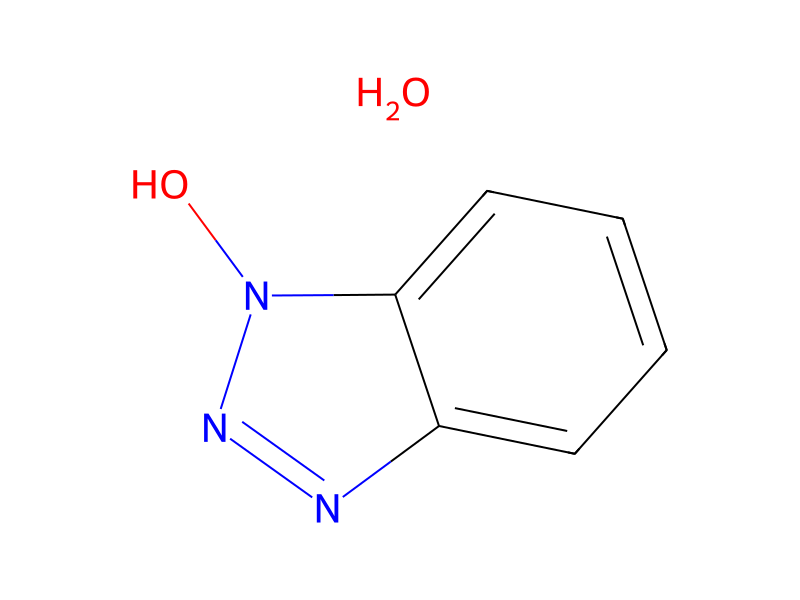
Cl.[CH3:2][S:3][C:4]1[CH:11]=[CH:10][CH:9]=[CH:8][C:5]=1[CH2:6][NH2:7].C(N(CC)CC)C.[N:19]1[C:28]2[C:23](=[CH:24][N:25]=[CH:26][CH:27]=2)[CH:22]=[CH:21][C:20]=1[C:29](O)=[O:30].O.ON1C2C=CC=CC=2N=N1>CN(C=O)C>[CH3:2][S:3][C:4]1[CH:11]=[CH:10][CH:9]=[CH:8][C:5]=1[CH2:6][NH:7][C:29]([C:20]1[CH:21]=[CH:22][C:23]2[C:28](=[CH:27][CH:26]=[N:25][CH:24]=2)[N:19]=1)=[O:30]Participants
6
Reactant 4



Product 1

Reagents, catalysts & solvents 1

Procedure
To a stirring mixture of 2-methylsulfanylbenzylamine hydrochloride (81.7 mg, 0.431) in anhydrous DMF (1.0 mL) was added triethylamine (60.0 μL, 0.431 mmol). After 5 minutes, 2-[1,6]naphthyridinecarboxylic acid (50 mg, 0.287 mmol), 1-hydroxybenzotriazole hydrate (42.7 mg, 0.316 mmol), and 1-(3-dimethylaminopropyl)-3-ethylcarboiimide hydrochloride (61.8 mg, 0.316 mmol) were added sequentially. The resulting mixture was allowed to stir at room temperature overnight. The solvent was removed under vacuum. Flash column chromatography of the residue (50% hexane/ethyl acetate to 100% ethyl acetate) afforded the desired product as a light brown solid (88.2 mg, 99%): m.p. 102-103° C.
Workup
- customThe solvent was removed under vacuum
Sources & evidence
- ORD record
- ord-8b82b5603e12420e935721e459160977
- Source dataset
- uspto-grants-1999_08
- Patent number
- US05945431
Reaction notes
Loading…