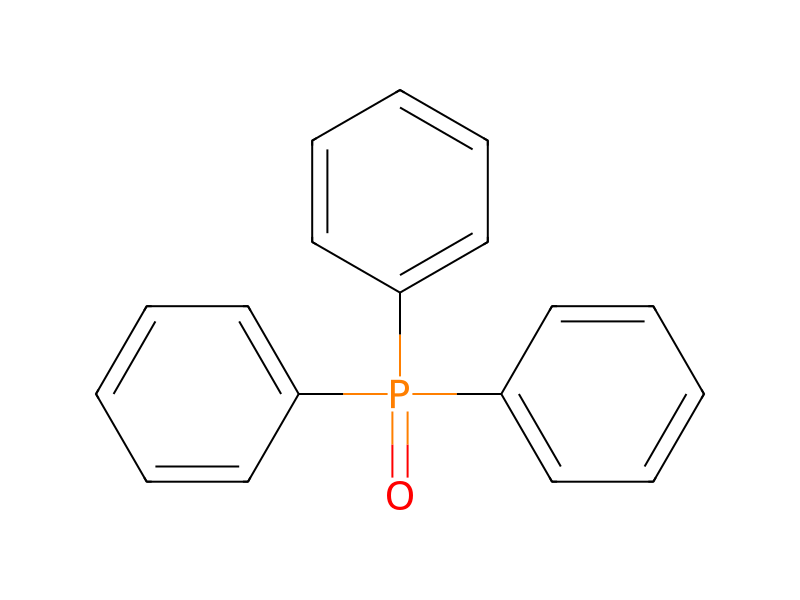
Bromide ion → Triphenylphosphine Oxide
Reaction equation

C(Cl)(=[O:6])CCCC.OC1C=CC([N+]([O-])=O)=CC=1C[P+:12]([C:25]1[CH:30]=[CH:29][CH:28]=[CH:27][CH:26]=1)([C:19]1[CH:24]=[CH:23][CH:22]=[CH:21][CH:20]=1)[C:13]1[CH:18]=[CH:17][CH:16]=[CH:15][CH:14]=1.[Br-].N1C=CC=CC=1.C(N(CC)CC)C>C(Cl)(Cl)Cl.C1(C)C=CC=CC=1>[C:13]1([P:12](=[O:6])([C:25]2[CH:30]=[CH:29][CH:28]=[CH:27][CH:26]=2)[C:19]2[CH:20]=[CH:21][CH:22]=[CH:23][CH:24]=2)[CH:14]=[CH:15][CH:16]=[CH:17][CH:18]=1Participants
Reactant 5





Product 1
Reagents, catalysts & solvents 2


Procedure
113.5 g (0.94 mole) of pentanoyl chloride are added slowly with stirring to a mixture of 370 g (0.75 mole) of 2-hydroxy 5-nitrobenzyltriphenylphosphonium, bromide and 120.2 g (1.52 mole) of pyridine in 700 ml of chloroform. The mixture is heated at reflux for 2 hours. 2800 ml of toluene are added and 1400 ml of solvents are distilled. 228 g (2.28 moles) of triethylamine are then added and the mixture is heated at reflux for 3 hours. It is allowed to cool, the triphenylphosphine-oxide, formed is filtered off, washed with ethyl acetate and the filtrate is concentrated in a vacuum. The viscous residue obtained is dissolved in acetonitrile and extracted with pentane in a liquid-liquid, extraction apparatus. The solution is dried over sodium sulfate, filtered and evaporated to dryness.
Workup
- temperatureThe mixture is heated
- temperatureat reflux for 2 hours
- distillation1400 ml of solvents are distilled
- temperaturethe mixture is heated
- temperatureat reflux for 3 hours
- temperatureto cool
Sources & evidence
- ORD record
- ord-3a429c33c3f544a2860c3c112269bf97
- Source dataset
- uspto-grants-1993_06
- Patent number
- US05223510
Reaction notes
Loading…