Ammonia → HCID 10290898, compound
Reaction equation

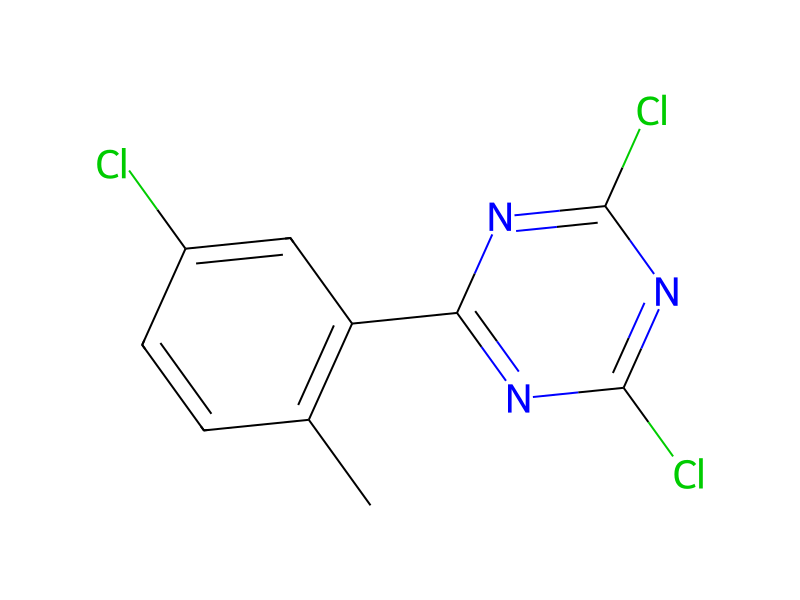
Cl[C:2]1[N:7]=[C:6](Cl)[N:5]=[C:4]([C:9]2[CH:14]=[C:13]([Cl:15])[CH:12]=[CH:11][C:10]=2[CH3:16])[N:3]=1.[CH:17]([C:19]1[CH:24]=[CH:23][C:22]([NH2:25])=[CH:21][CH:20]=1)=[CH2:18].C([N:29](CC)C(C)C)(C)C.N>O1CCCC1>[Cl:15][C:13]1[CH:12]=[CH:11][C:10]([CH3:16])=[C:9]([C:4]2[N:5]=[C:6]([NH:25][C:22]3[CH:23]=[CH:24][C:19]([CH:17]=[CH2:18])=[CH:20][CH:21]=3)[N:7]=[C:2]([NH2:29])[N:3]=2)[CH:14]=1Participants





Conditions
- Temperature
- -78 °C
Procedure
A mixture of 2,4-dichloro-6-(5-chloro-2-methyl-phenyl)-[1,3,5]triazine (500 mg, 1.8 mmol), 4-vinylphenylamine (228 mg, 1.9 mmol), tetrahydrofuran (20 ml), and N,N-diisopropylethylamine (0.63 ml, 3.6 mmol) was stirred for 2 hours. The mixture was transferred to a pressure bottle and chilled to −78° C. A slow stream of ammonia gas was passed into the mixture for 2 minutes and the bottle was sealed. After stirring at room temperature for 60 hours, the mixture was concentrated under reduced pressure. The residue was purified by flash chromatography on silica gel eluting with ethyl acetate-hexane (1:3) to provide the title compound (260 mg, 41% yield). 1H NMR (acetone-d6) 8.78 (br s, 1H), 7.92 (d, J=2.4 Hz, 1H), 7.88 (d, J=8.3 Hz, 2H), 7.44 (d, J=8.6 Hz, 2H), 7.39 (dd, J=2.4 Hz, J=8.2 Hz, 1H), 7.30 (d, J=8.2 Hz, 1H), 6.74 (dd, J=11.0 Hz, J=17.6 Hz, 1H), 6.64 (br s, 1H), 5.73 (dd, J=1.0 Hz, J=17.6 Hz, 1H), 5.15 (dd, J=1.0 Hz, J=11.0 Hz, 1H), 2.61 (s, 3H).
Workup
- customthe bottle was sealed
- stirringAfter stirring at room temperature for 60 hours
- concentrationthe mixture was concentrated under reduced pressure
- customThe residue was purified by flash chromatography on silica gel eluting with ethyl acetate-hexane (1:3)
Sources & evidence
- ORD record
- ord-bfc14fa99c464d99ae3b3aea3e24da60
- Source dataset
- uspto-grants-2007_11
- Patent number
- US07291616B2
Reaction notes
Loading…