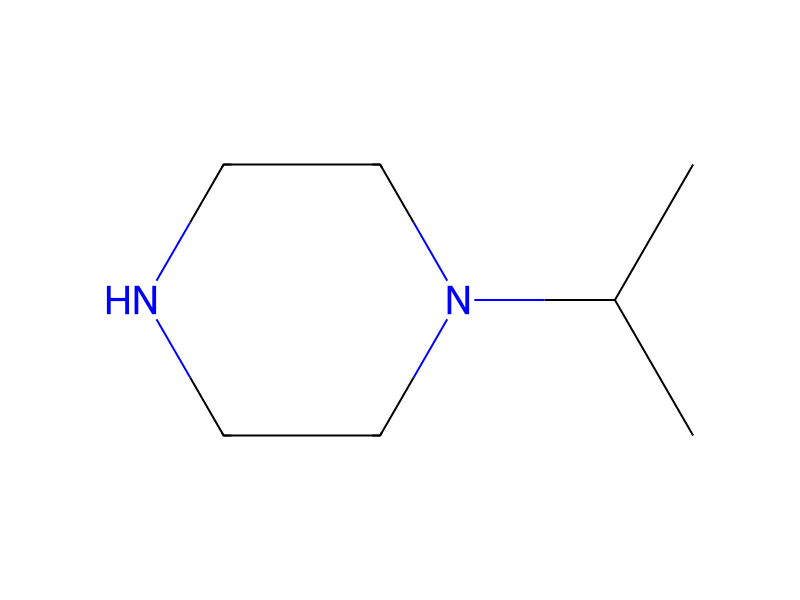
1-Isopropylpiperazine → Hydrochloric Acid
Reaction equation

[Cl:1][C:2]1[N:7]=[N:6][C:5]([C:8]2[CH:15]=[CH:14][C:11]([C:12]#[N:13])=[CH:10][CH:9]=2)=[CH:4][CH:3]=1.[CH:16]([N:19]1[CH2:24][CH2:23][NH:22][CH2:21][CH2:20]1)([CH3:18])[CH3:17].CCN(C(C)C)C(C)C>CN(C)C1C=CN=CC=1.CS(C)=O.ClCCl.O>[CH:16]([N:19]1[CH2:24][CH2:23][N:22]([C:2]2[N:7]=[N:6][C:5]([C:8]3[CH:15]=[CH:14][C:11]([C:12]#[N:13])=[CH:10][CH:9]=3)=[CH:4][CH:3]=2)[CH2:21][CH2:20]1)([CH3:18])[CH3:17].[ClH:1]Participants
Reactant 3


Product 2


Reagents, catalysts & solvents 4




Conditions
- Temperature
- 100 °C
Procedure
A suspension of 4-(6-chloro-pyridazin-3-yl)-benzonitrile (1 g, 4.64 mmol; prepared as described in U.S. Pat. No. 4,112,095), isopropylpiperazine (0.654 g, 5.1 mmol), DIPEA (1.199 g, 9.27 mmol) and 4-(dimethylamino)pyridine (0.057 g, 0.464 mmol) in DMSO (4 ml) was stirred and heated to 100° C. for 20 h. After cooling to room temperature, the mixture was diluted with dichloromethane (25 ml) and water (35 ml) and stirred for 5 min. The organic phase was separated, washed with water (50 ml) and brine (50 ml), and acidified to pH 2 by addition of 1 N hydrochloric acid. The mixture was extracted with water (30 ml), and the aqueous phase was washed with dichloromethane (10 ml) and concentrated in vacuo to give a solid, which was collected and stripped with ethanol to afford the title compound as a crystalline hydrochloride (1.33 g, 76%).
Workup
- customprepared
- temperatureAfter cooling to room temperature
- customThe organic phase was separated
- washwashed with water (50 ml) and brine (50 ml)
- additionacidified to pH 2 by addition of 1 N hydrochloric acid
- extractionThe mixture was extracted with water (30 ml)
- washthe aqueous phase was washed with dichloromethane (10 ml)
- concentrationconcentrated in vacuo
- customto give a solid, which
- customwas collected
Sources & evidence
- ORD record
- ord-a58f64295f964de8b42f5918df018dd0
- Source dataset
- uspto-grants-2007_11
- Patent number
- US07294626B2
Reaction notes
Loading…