Hydroquinone → (2-Methoxy-2-methyl-1,3-dioxolan-4-yl)methyl prop-2-enoate
Reaction equation

[C:1]([OH:5])(=[O:4])[CH:2]=[CH2:3].[C:6]1([CH3:16])[CH:11]=CC(S(O)(=O)=O)=CC=1.C1(C=CC(O)=CC=1)O.C1OC1CO.[C:30]([O:36]C)([O:34]C)([O:32][CH3:33])[CH3:31]>>[C:1]([O:5][CH2:16][CH:6]1[CH2:11][O:36][C:30]([O:32][CH3:33])([CH3:31])[O:34]1)(=[O:4])[CH:2]=[CH2:3]Participants
6



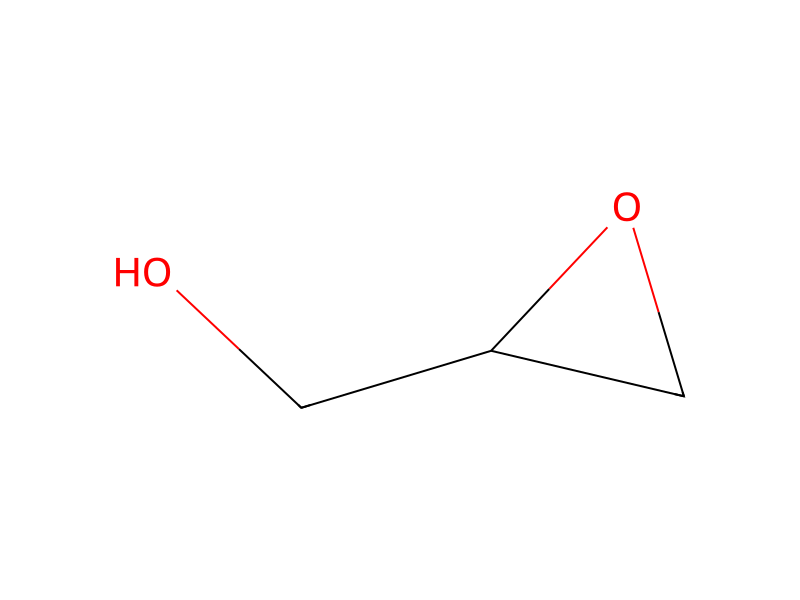


Conditions
- Temperature
- 104 °C
Procedure
47 g of acrylic acid and 3.04 g of p-toluenesulfonic acid were initially charged in a round-bottom flask together with 0.2 g of hydroquinone and heated to 104° C. 40 g of glycidol were added dropwise to this reactant mixture and the resulting solution was stirred at 100° C. for 45 minutes. Subsequently, the reaction mixture was cooled to 25° C. 84 g of trimethyl orthoacetate were added dropwise to this reaction mixture, which was subsequently stirred at 25° C. for one hour. The reaction mixture was then freed of the low boilers present by means of a distillation. Subsequently, a vacuum distillation was carried out at 4 mbar and 95° C. 4-Acryloyloxymethyl-2-methoxy-2-methyl-1,3-dioxolane was obtained in a yield of 56%.
Workup
- temperatureSubsequently, the reaction mixture was cooled to 25° C
- stirringwas subsequently stirred at 25° C. for one hour
- distillationThe reaction mixture was then freed of the low boilers present by means of a distillation
- distillationSubsequently, a vacuum distillation
- customwas carried out at 4 mbar and 95° C
Sources & evidence
- ORD record
- ord-538fbce3170148bc80b6d9a69032d7b8
- Source dataset
- uspto-grants-2007_11
- Patent number
- US07297812B2
Reaction notes
Loading…