Phthalonitrile → Dichlorotitanium phthalocyanine
Reaction equation

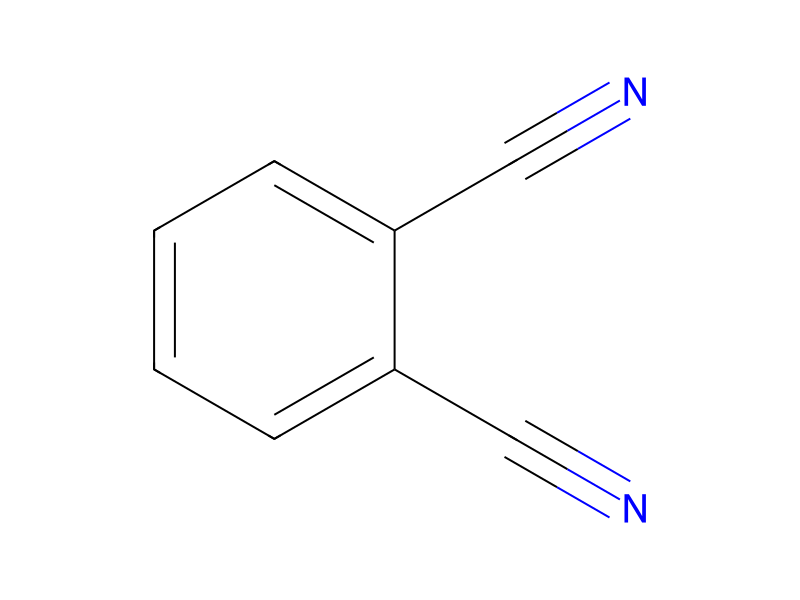
[CH:1]1[CH:6]=[C:5]([C:7]#[N:8])[C:4]([C:9]#[N:10])=[CH:3][CH:2]=1.[Ti:11](Cl)(Cl)([Cl:13])[Cl:12]>ClC1C2C(=CC=CC=2)C=CC=1>[Cl:12][Ti:11][Cl:13].[CH:1]1[CH:2]=[CH:3][C:4]2[C:5](=[C:7]3[N:8]=[C:7]4[N:10]=[C:9]([C:4]5[CH:3]=[CH:2][CH:1]=[CH:6][C:5]=54)[N:10]=[C:9]4[NH:8][C:7]([C:5]5[CH:6]=[CH:1][CH:2]=[CH:3][C:4]=54)=[N:10][C:9]4=[N:8][C:7]([C:5]5[CH:6]=[CH:1][CH:2]=[CH:3][C:4]=54)=[N:10][C:9]=2[NH:8]3)[CH:6]=1Participants
Reactant 2

Product 1

Reagents, catalysts & solvents 1

Procedure
In this comparative example, α-titanyloxyphthalocyanine was prepared by the method disclosed in Japanese Patent Application Laying-open No. 62-134651. That is, a mixture of 40 g of phthalodinitrile, 18 g of titanium tetrachloride, and 500 cc of chloronaphthalene was stirred at the temperature of 240° C. to 2500° C. for 3 hours in nitrogenous atmosphere to completely react with each other. The mixture was filtrated after the reaction, and as a result dichlorotitanium phthalocyanine was obtained. The obtained dichlorotitanium was mixed with 300 cc of concentrated ammonium solution to obtain a mixture. Then the mixture was heat-refluxed for 1 hour and subjected to the purification by using a Soxhlet extractor. Consequently, titanyloxyphthalocyanine was obtained by drying the purified product. The resultant titanyloxyphthalocyanine was confirmed as α-type crystal having an X-ray diffraction spectrum which is the same as the one shown in FIG. 3.
Workup
- customto completely react with each other
- filtrationThe mixture was filtrated
- customafter the reaction
Sources & evidence
- ORD record
- ord-24edd78d5b894627b031d2d04954a09f
- Source dataset
- uspto-grants-1998_04
- Patent number
- US05736282
Reaction notes
Loading…