Benzenepropanoic acid → HCID 18928733, compound
Reaction equation

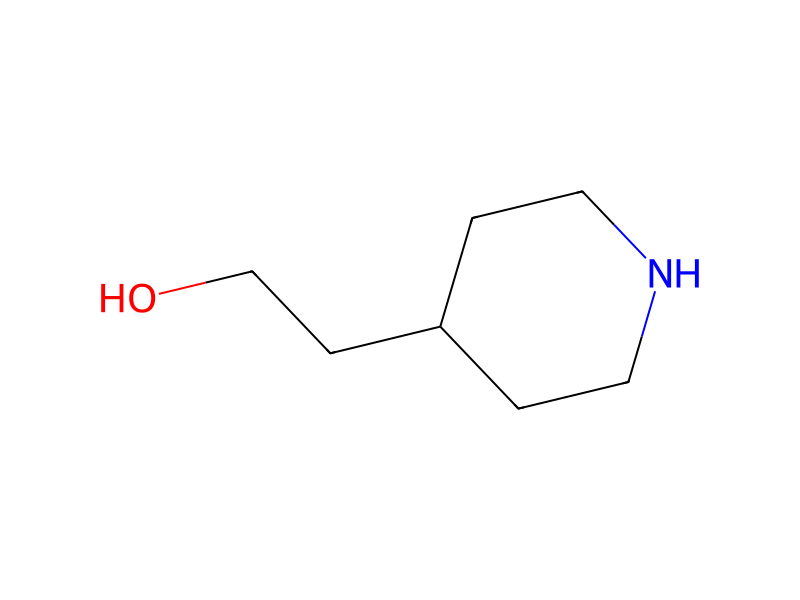
[C:1]1([CH2:7][CH2:8][C:9]([OH:11])=O)[CH:6]=[CH:5][CH:4]=[CH:3][CH:2]=1.S(Cl)(Cl)=O.[NH:16]1[CH2:21][CH2:20][CH:19]([CH2:22][CH2:23][OH:24])[CH2:18][CH2:17]1.C(N(CC)CC)C>C1(C)C=CC=CC=1.ClCCl>[OH:24][CH2:23][CH2:22][CH:19]1[CH2:20][CH2:21][N:16]([C:9](=[O:11])[CH2:8][CH2:7][C:1]2[CH:2]=[CH:3][CH:4]=[CH:5][CH:6]=2)[CH2:17][CH2:18]1Participants
Reactant 4



Product 1

Reagents, catalysts & solvents 2


Conditions
- Temperature
- 0 °C
Procedure
A mixture of 3-phenylpropionic acid (29.5 g) and thionyl chloride (35 ml) in dry toluene (100 ml) was heated under reflux at 80°-100° C. for two hours. The mixture was then evaporated. The residue was treated with two portions of toluene and the resultant solution was evaporated on each occasion yielding an oil which was then dissolved in dry dichloromethane (50 ml). The solution was added dropwise to a stirred solution of 4-piperidine-ethanol (25.2 g) and triethylamine (22.2 g) in dichloromethane (250 ml) at 0° C. over one hour, maintaining the temperature at 0° C. The mixture was allowed to warm to 20° C. and was stirred for 18 hours and then washed with saturated sodium bicarbonate solution. The organic layer was separated and evaporated to dryness. The residue was dissolved in dioxan (20 ml) and 1M sodium hydroxide solution (20 ml) was then added. The solution was stirred at 20° C. for 20 hours and then stirred at 40° C. for a further 4 hours. The solution was evaporated and the residue treated with dilute sodium hydroxide solution and then extracted with ethyl acetate. The combined ethyl acetate extracts were washed (dilute hydrochloric acid, brine), dried and evaporated to give 4-(2-hydroxyethyl)-1-(3-phenylpropionyl)piperidine as an oil.
Workup
- temperaturewas heated
- temperatureunder reflux at 80°-100° C. for two hours
- customThe mixture was then evaporated
- additionThe residue was treated with two portions of toluene
- customthe resultant solution was evaporated on each occasion
- customyielding an oil which
- temperatureto warm to 20° C.
- washwashed with saturated sodium bicarbonate solution
- customThe organic layer was separated
- customevaporated to dryness
- dissolutionThe residue was dissolved in dioxan (20 ml)
- addition1M sodium hydroxide solution (20 ml) was then added
- stirringThe solution was stirred at 20° C. for 20 hours
- stirringstirred at 40° C. for a further 4 hours
- customThe solution was evaporated
- additionthe residue treated with dilute sodium hydroxide solution
- extractionextracted with ethyl acetate
- washThe combined ethyl acetate extracts were washed (dilute hydrochloric acid, brine)
- customdried
- customevaporated
Sources & evidence
- ORD record
- ord-d3dc09ebf4b842bba6a4a1699cb61eb2
- Source dataset
- uspto-grants-1998_04
- Patent number
- US05741800
Reaction notes
Loading…