M-Cresol → HCID 168648, compound
Reaction equation

[CH:1]1[C:6]([OH:7])=[CH:5][CH:4]=[C:3]([CH3:8])[CH:2]=1.[CH:9]1[C:14]([OH:15])=[CH:13][CH:12]=[CH:11][C:10]=1[CH3:16].[CH2:17]=[O:18]>O.O.C(O)(=O)C(O)=O.O>[CH:5]1[C:6]([OH:7])=[CH:1][CH:2]=[C:3]([CH3:8])[CH:4]=1.[CH:9]1[C:14]([OH:15])=[CH:13][CH:12]=[CH:11][C:10]=1[CH3:16].[CH2:17]=[O:18]Participants
Reactant 3
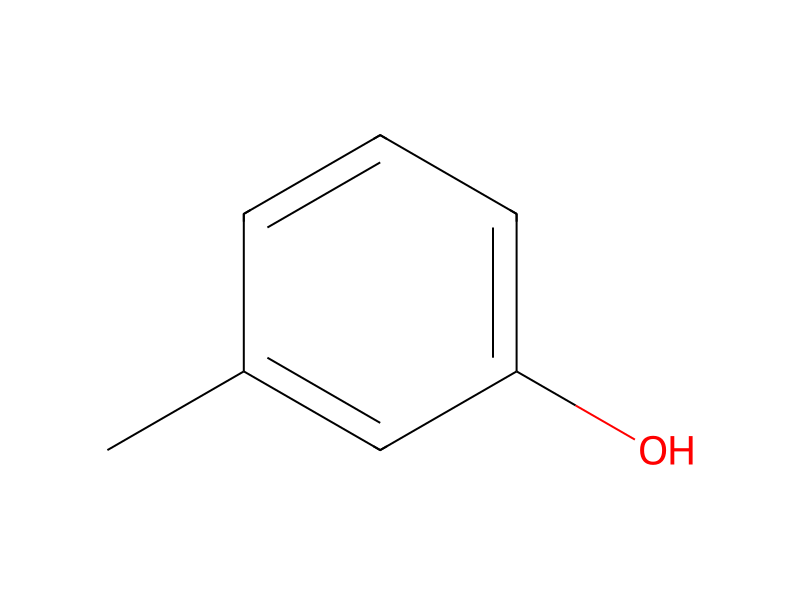


Product 1

Reagents, catalysts & solvents 2


Conditions
- Temperature
- 100 °C
Procedure
To a mixed solution of 60.0 g (0.55 mol) of p-cresol, 60.0 g (0.55 mol) of m-cresol and 2.4 g of oxalic acid dihydrate was added dropwise 33.7 g (0.42 mol) of a 37% formaldehyde solution with stirring at 100° C., and the mixture was reacted with stirring at 100±50° C. for 4 hours. After the end of the reaction, 2,000 ml of water was poured into the reaction solution to cause precipitation. After removing the supernatant by decantation, the precipitate was dissolved in 120 ml of acetone and 1,200 ml of water was poured into the solution to cause precipitation. After the supernatant has been decanted, the solution was evaporated to dryness under reduced pressure to give 74.5 g of residual p-cresol/m-cresol/formaldehyde polycondensate as faintly yellow-tinted waxy crystals. Mw≈880; Mw/Mn=2.07 (GPC with polystyrene calibration).
Workup
- customthe mixture was reacted
- stirringwith stirring at 100±50° C. for 4 hours
- additionwas poured into the reaction solution
- customprecipitation
- customAfter removing the supernatant by decantation
- dissolutionthe precipitate was dissolved in 120 ml of acetone
- addition1,200 ml of water was poured into the solution
- customprecipitation
- customAfter the supernatant has been decanted
- customthe solution was evaporated to dryness under reduced pressure
Sources & evidence
- ORD record
- ord-05d848cc7e4b4d96811e6138d437ff2d
- Source dataset
- uspto-grants-1999_11
- Patent number
- US05976759
Reaction notes
Loading…