Tetrahydrofuran → N,N'-Dicyclohexylurea
Reaction equation

C1C[O:4]CC1.[CH2:6]1[CH2:11][CH2:10][CH:9]([N:12]=[C:13]=[N:14][CH:15]2[CH2:20][CH2:19][CH2:18][CH2:17][CH2:16]2)[CH2:8][CH2:7]1.C(N)CCCCCCCCCCC>N1C=CC=CC=1>[C:13]([NH:12][CH:9]1[CH2:8][CH2:7][CH2:6][CH2:11][CH2:10]1)([NH:14][CH:15]1[CH2:20][CH2:19][CH2:18][CH2:17][CH2:16]1)=[O:4]Participants
Reactant 3



Product 1
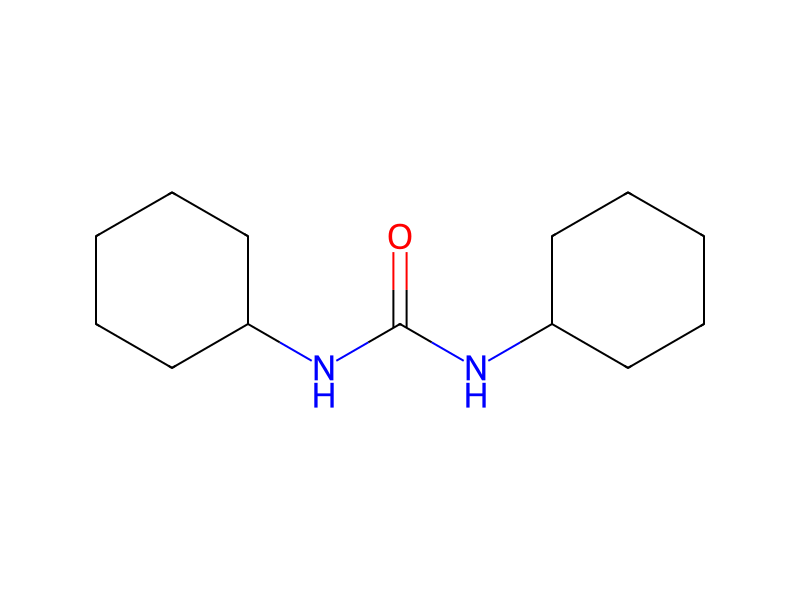
Reagents, catalysts & solvents 1

Procedure
If desacylsaponins are soluble in anhydrous pyridine alone or mixed with anhydrous THF, the reaction can be carried out with DCC. 100 mg of (4) (60 μmoles) are dissolved in pyridine and/or THF, using no less than 1 ml but no more than 5 ml of solvent. 0.4 ml of a 0.3M dodecylamine solution (120 μmoles) in pyridine and/or THF is added to the desacylsaponin solution, followed by 120 μmoles of dry DCC and 120 μmoles of dry NHS. The mixture is allowed to react with mixing overnight at 0° C. to 10° C. Insoluble dicyclohexylurea is formed, which is removed by centrifugation. The supernatant containing the conjugated desacylsaponins (5) is diluted with 10 volumes of EtOAc to precipitate (5) and to remove the free alkyl amine, residual DCC, and NHS. The precipitate is dissolved in water and extracted with EtOAc before concentration with a rotoevaporator and lyophilization. Modification is confirmed by mass spectra.
Workup
- customthe reaction
- customto react
- additionwith mixing overnight at 0° C. to 10° C
Sources & evidence
- ORD record
- ord-352c806f55844d489d626212cc2a8efb
- Source dataset
- uspto-grants-1999_11
- Patent number
- US05977081
Reaction notes
Loading…