Sodium Hydroxide → 2,3-Dihydroxybutanedioic Acid
Reaction equation

[C:1]([OH:10])(=[O:9])[C@H:2]([C@@H:4]([C:6]([OH:8])=[O:7])[OH:5])[OH:3].[OH-].[Na+]>O>[C:1]([OH:10])(=[O:9])[C@H:2]([C@@H:4]([C:6]([OH:8])=[O:7])[OH:5])[OH:3].[C:1]([OH:10])(=[O:9])[CH:2]([CH:4]([C:6]([OH:8])=[O:7])[OH:5])[OH:3].[C@H:2]([OH:3])([C:1]([OH:10])=[O:9])[C@H:4]([OH:5])[C:6]([OH:8])=[O:7]Participants
6
Reactant 2

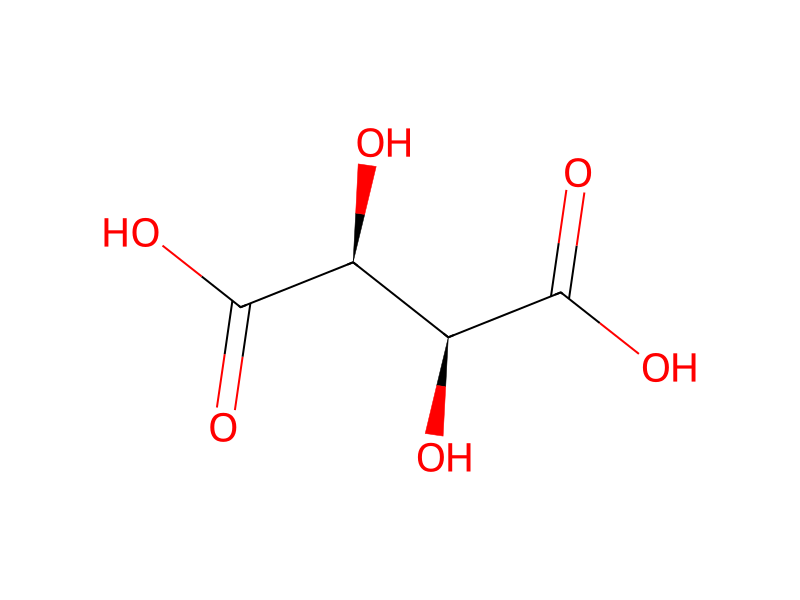
Product 3


Reagents, catalysts & solvents 1

Conditions
- Temperature
- 116 °C
Procedure
Into a test tube equipped with a reflux condenser were charged 4.86 g of D-tartaric acid, 7.78 g of sodium hydroxide and 10.6 g of water. The mixture was heated at 116°C in an oil bath for 8 hours under reflux. Analysis of the resulting reaction mixture gave 0.11 g of unreacted D-tartaric acid, 2.45 g of DL-tartaric acid and 1.79 g of meso-tartaric acid. The conversion of D-tartaric acid to DL-tartaric acid was 50.4%.
Workup
- customInto a test tube equipped with a reflux condenser
- temperatureunder reflux
- customAnalysis of the resulting reaction mixture
Sources & evidence
- ORD record
- ord-15349bec39ba4659962d2eb6fc9bed21
- Source dataset
- uspto-grants-1976_04
- Patent number
- US03953504
Reaction notes
Loading…