4-Hydroxybenzyl Alcohol → HCID 19594010, compound
Reaction equation

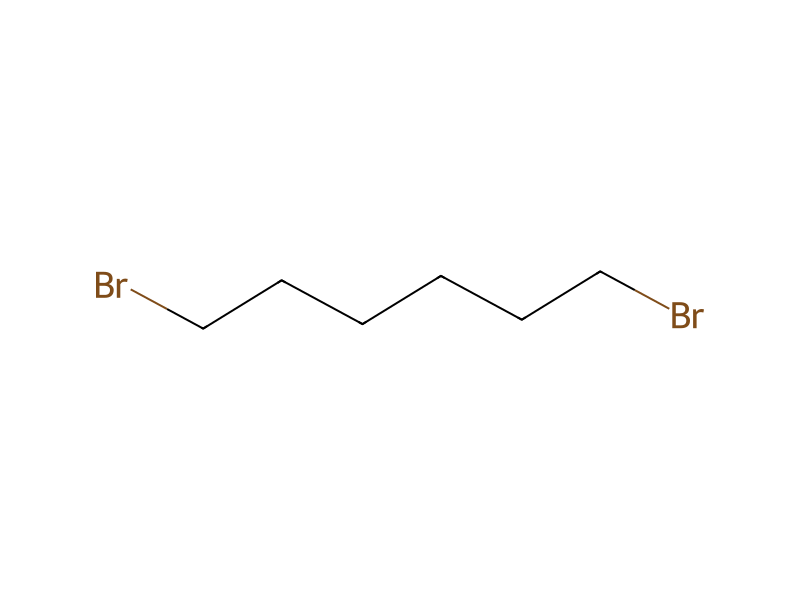
[OH:1][C:2]1[CH:9]=[CH:8][C:5]([CH2:6][OH:7])=[CH:4][CH:3]=1.[C:10](=[O:13])([O-])[O-].[K+].[K+].Br[CH2:17][CH2:18][CH2:19][CH2:20][CH2:21][CH2:22]Br.[OH2:24]>CN(C)C=O>[OH:7][CH2:6][C:5]1[CH:8]=[CH:9][C:2]([O:1][CH2:17][CH2:18][CH2:19][CH2:20][CH2:21][CH2:22][O:24][C:2]2[CH:9]=[CH:8][C:5]([CH2:10][OH:13])=[CH:4][CH:3]=2)=[CH:3][CH:4]=1Participants
Reactant 4



Product 1

Reagents, catalysts & solvents 1

Conditions
- Temperature
- 60 °C
Procedure
4-Hydroxybenzyl alcohol (24.82 g, 0.2 mole) was added to a stirred suspension of finely ground potassium carbonate (42.0 g, 0.4 mole) in dry dimethylformamide (250 mL). The resultant mixture was stirred at 60° C. under dry nitrogen for 10 minutes, then 1,6-dibromohexane (24.4 g, 0.1 mole) was added. The reaction mixture was maintained at 60° C. for 5 hours, then allowed to cool to room temperature and stirred for 17 hours. The reaction mixture was then poured slowly into ice/water (800 mL). A tan precipitate formed, which was collected by filtration, washed with water, and dried in air to give a sticky solid. This material was triturated with 2-propanol (100 mL) and then with cold water (200 mL), to give the desired product as a powder (13.8 g, 42% yield) which was collected by (slow and difficult) filtration. The compound melted at 96°-110° C., and its structure was confirmed by mass spectroscopy and by 1H and 13C NMR spectroscopy.
Workup
- temperatureto cool to room temperature
- customA tan precipitate formed
- filtrationwhich was collected by filtration
- washwashed with water
- customdried in air
- customto give a sticky solid
- customThis material was triturated with 2-propanol (100 mL)
Sources & evidence
- ORD record
- ord-6fdcd8deba1d4fcb8331d1ba6d9a6f55
- Source dataset
- uspto-grants-1995_03
- Patent number
- US05395736
Reaction notes
Loading…