Acetic Acid → HCID 22251894, compound
Reaction equation

Cl[CH2:2][C:3]([O-:5])=[O:4].C(Br)[CH2:7][CH2:8][CH2:9][CH2:10][CH2:11][CH2:12][CH2:13][CH2:14][CH3:15].[CH2:17]1O[CH2:18]1.[Mg].[C:21](=O)=O.[C:24](O)(=O)[CH3:25]>[Pd]>[CH3:21][CH:9]([CH2:8][CH2:7][CH2:24][CH2:25][CH2:17][CH3:18])[CH2:10][CH2:11][CH2:12][CH2:13][CH2:14][CH2:15][CH2:2][C:3]([OH:5])=[O:4]Participants
Reactant 6



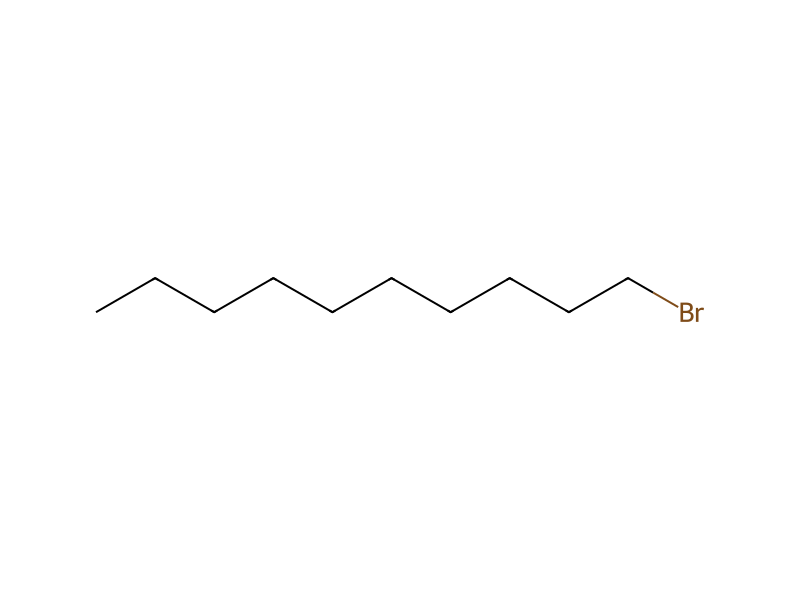


Product 1

Reagents, catalysts & solvents 1

Procedure
See GENERAL PROCEDURE I. Hexyl bromide (compound (1), R═CH3(CH2)5—) is converted to its Grignard reagent with magnesium in dry ether (I, Step (a)). To this is added 5-chloro-2-pentanone (Aldrich C6,2660-3) (I, Step (b)). The reaction mixture is worked up with acetic anhydride (I, Step (c)) to form chloroacetate (3). Acetic acid is eliminated by refluxing (3) in a suitable solvent, e.g., benzene (1, Step (d)) yielding a mixture of chloro-olefin isomers (4) (R═CH3(CH2)5—). (4) is converted to its Grignard reagent following standard practice. (I, Step (e)). The Grignard reagent is treated with ethylene oxide followed by aqueous acidic workup (I, Step (h)), hydrogenation (I, Step (i)), Pd catalyst, and hydrobromination (I, Step (j)). The alkyl bromide (6) (R═CH3(CH2)5—, y=5) is converted to the Grignard reagent with magnesium (I, Step (k)) which is treated with ethylene oxide and aqueous acidic workup (1, Step (h)) and hydrobromination (I, Step (j)). The alkyl bromide (6) (R═CH3(CH2)5—, y=7) is converted to the Grignard reagent with magnesium (I, Step (k)) which is treated with carbon dioxide and aqueous acidic workup (I, Step (l)) to give the product, 9-methylpentadecanoic acid, (7).
Workup
- customyielding
Sources & evidence
- ORD record
- ord-27767bd1a6e9448dabbdbb2686cf20d5
- Source dataset
- uspto-grants-2006_01
- Patent number
- US06992057B2
Reaction notes
Loading…