3-Bromopyridine → 1,1-Dimethoxy-2-hydroxy-2-(3-pyridyl)-3-(2,4-dichlorophenyl)-propane
Reaction equation

[CH3:1][O:2][CH:3]([O:15][CH3:16])[C:4](=[O:14])[CH2:5][C:6]1[CH:11]=[CH:10][C:9]([Cl:12])=[CH:8][C:7]=1[Cl:13].[N:17]1[CH:22]=[CH:21][CH:20]=[C:19]([Li])[CH:18]=1.C([Li])CCC.BrC1C=NC=CC=1>C(OCC)C.O.C(O)(C)C>[CH3:16][O:15][CH:3]([O:2][CH3:1])[C:4]([OH:14])([C:19]1[CH:18]=[N:17][CH:22]=[CH:21][CH:20]=1)[CH2:5][C:6]1[CH:11]=[CH:10][C:9]([Cl:12])=[CH:8][C:7]=1[Cl:13]Participants
8
Reactant 4
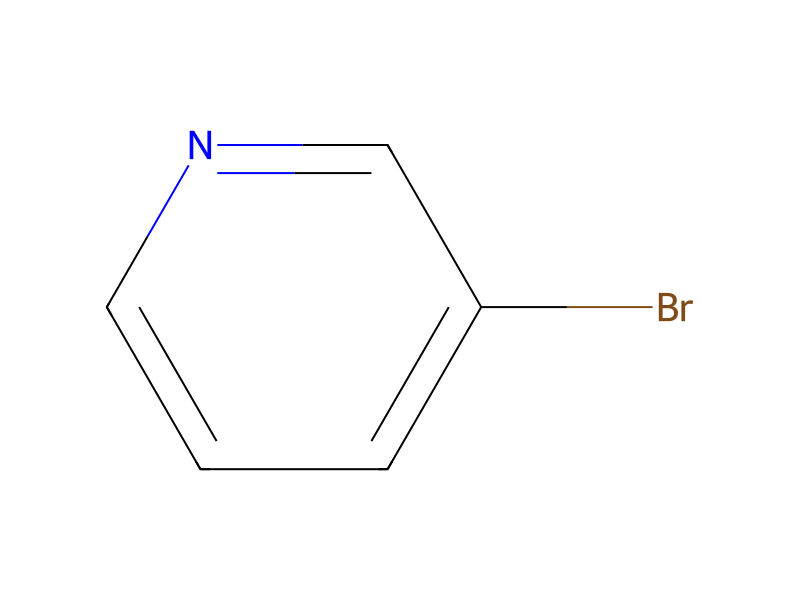



Product 1

Reagents, catalysts & solvents 3



Conditions
- Temperature
- 0 °C
Procedure
At -70° C., 88.9 g (0.337 mol) of 1,1-dimethoxy-3-(2,4-dichlorophenyl)propan-2-one in 100 ml of diethyl ether (Et2O) is dripped into a solution of 0.371 mol of 3-pyridyllithium in 1.1 liters of Et2O prepared from n-butyllithium and 3-bromopyridine. After half an hour at -70° C., the solution is slowly heated up to 0° C. Isopropanol and then water is added, and the reaction solution is extracted with 1N hydrochloric acid. The acidic aqueous phase is then neutralized with NaHCO3 and extracted with methylene chloride (CH2Cl2). After drying over Na2SO4, all the volatile constituents are removed in a rotary evaporator. A yellowish red oil is obtained. Yield: 56.1 g (48.7%).
Workup
- customAt -70° C.
- waitAfter half an hour at -70° C.
- extractionthe reaction solution is extracted with 1N hydrochloric acid
- extractionextracted with methylene chloride (CH2Cl2)
- dry with materialAfter drying over Na2SO4, all the volatile constituents
- customare removed in a rotary evaporator
- customA yellowish red oil is obtained
Sources & evidence
- ORD record
- ord-4193d6ccfc91442397795e8525ea61e9
- Source dataset
- uspto-grants-1993_03
- Patent number
- US05196433
Reaction notes
Loading…