Sodium hydride → 4-bromo-1-{[2-(trimethylsilyl)ethoxy]methyl}-1H-pyrrolo[2,3-b]pyridine
Reaction equation

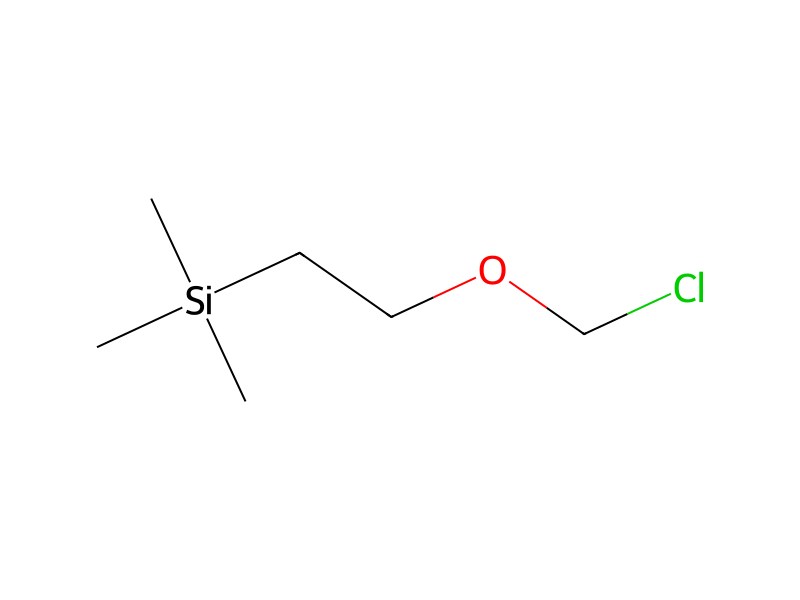
[Br:1][C:2]1[CH:7]=[CH:6][N:5]=[C:4]2[NH:8][CH:9]=[CH:10][C:3]=12.[H-].[Na+].[CH3:13][Si:14]([CH3:21])([CH3:20])[CH2:15][CH2:16][O:17][CH2:18]Cl>CN(C=O)C>[Br:1][C:2]1[CH:7]=[CH:6][N:5]=[C:4]2[N:8]([CH2:18][O:17][CH2:16][CH2:15][Si:14]([CH3:21])([CH3:20])[CH3:13])[CH:9]=[CH:10][C:3]=12Participants
Reactant 3


Product 1

Reagents, catalysts & solvents 1

Procedure
A solution of 4-bromo-1H-pyrrolo[2,3-b]pyridine (10.0 g, 0.0508 mol) in DMF (40 mL) was cooled under nitrogen to 0° C. Sodium hydride (3.0 g, 0.075 mol) was added portionwise. The reaction was stirred for 1 hour. To this mixture, [2-(trimethylsilyl)ethoxy]methyl chloride (10.8 mL, 0.061 mol) was added slowly. After being stirred at 0° C. for 1 hour, the reaction was quenched with water and extracted with EtOAc twice. The combined extracts were washed with water, brine, dried over anhydrous sodium sulfate, filtered and concentrated under reduced pressure. The residue was purified by silica gel chromatography, eluting with 0-25% EtOAc/hexanes to afford 15.7 g (94.5%) of the desired product as a yellowish oil. LC/MS found: 327.1, 329.1 (M+H)+.
Workup
- stirringAfter being stirred at 0° C. for 1 hour
- customthe reaction was quenched with water
- extractionextracted with EtOAc twice
- washThe combined extracts were washed with water, brine
- dry with materialdried over anhydrous sodium sulfate
- filtrationfiltered
- concentrationconcentrated under reduced pressure
- customThe residue was purified by silica gel chromatography
- washeluting with 0-25% EtOAc/hexanes
Sources & evidence
- ORD record
- ord-48a528467639455aa3a60dae27d7b40c
- Source dataset
- uspto-grants-2014_07
- Patent number
- US08765734B2
Reaction notes
Loading…