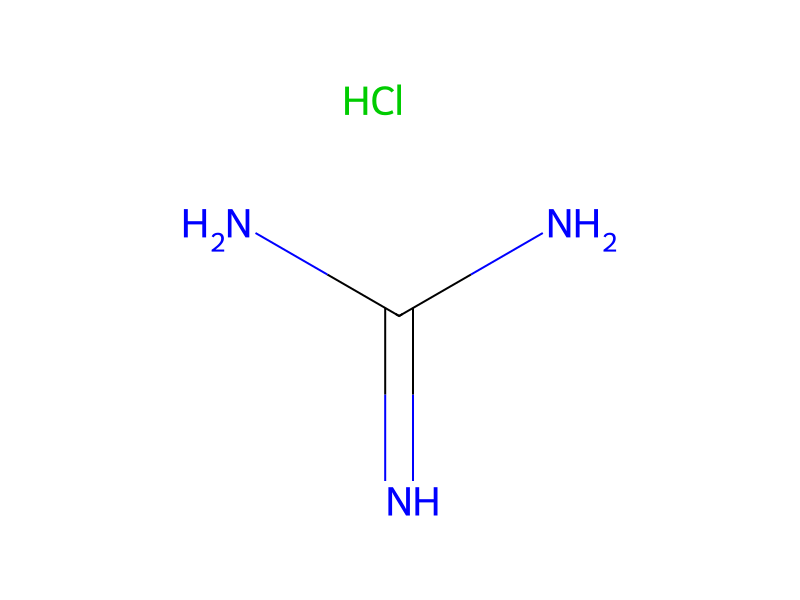
Guanidine Hydrochloride → 5-(2-Amino-pyrimidin-4-yl)-1H-pyrrole-3-carboxylic acid ethyl ester
Reaction equation

[CH2:1]([O:3][C:4]([C:6]1[CH:10]=[C:9]([C:11](=O)/[CH:12]=[CH:13]/N(C)C)[NH:8][CH:7]=1)=[O:5])[CH3:2].Cl.[NH2:19][C:20]([NH2:22])=[NH:21].CC[O-].[Na+]>C(O)C.O>[CH2:1]([O:3][C:4]([C:6]1[CH:10]=[C:9]([C:11]2[CH:12]=[CH:13][N:19]=[C:20]([NH2:22])[N:21]=2)[NH:8][CH:7]=1)=[O:5])[CH3:2]Participants
6
Reactant 3


Product 1

Reagents, catalysts & solvents 2


Conditions
- Temperature
- 110 °C
Procedure
To a suspension of 5-((E)-3-Dimethylamino-acryloyl)-1H-pyrrole-3-carboxylic acid ethyl ester (0.25 g, 1.06 mmol) in 4 mL of ethanol, guanidine hydrochloride (0.121 g, 1.27 mmol) and sodium ethylate (0.086 g, 1.27 mmol) were added. The mixture was heated to 110° C. overnight. Then, a further amount of sodium ethylate (0.086 g, 1.27 mmol) was added to the mixture and heating to 115° C. was prolonged for additional 24 hours. The resulting mixture was cooled at room temperature and diluted with water (2 mL). The solid was isolated by filtration, washed with 10 mL of water, dried in a vacuum oven at 40° C. affording to give 0.197 g (80%) of the title compound.
Workup
- additionwere added
- temperatureheating to 115° C.
- temperatureThe resulting mixture was cooled at room temperature
- customThe solid was isolated by filtration
- washwashed with 10 mL of water
- customdried in a vacuum oven at 40° C.
- customaffording
Sources & evidence
- ORD record
- ord-ec807a6216f546a8bdf60ddc6f805239
- Source dataset
- uspto-grants-2014_07
- Patent number
- US08772280B2
Reaction notes
Loading…