Resorcinol → HCID 10925060, compound
Reaction equation

Br[CH2:2][C:3]1[CH:8]=[CH:7][CH:6]=[CH:5][C:4]=1/[C:9](=[CH:14]\[O:15][CH3:16])/[C:10]([O:12][CH3:13])=[O:11].[OH:17][C:18]1[CH:19]=[C:20]([OH:24])[CH:21]=[CH:22][CH:23]=1.C(=O)([O-])[O-].[K+].[K+]>C(#N)C>[OH:17][C:18]1[CH:19]=[C:20]([CH:21]=[CH:22][CH:23]=1)[O:24][CH2:2][C:3]1[CH:8]=[CH:7][CH:6]=[CH:5][C:4]=1/[C:9](=[CH:14]\[O:15][CH3:16])/[C:10]([O:12][CH3:13])=[O:11]Participants
5
Reactant 3
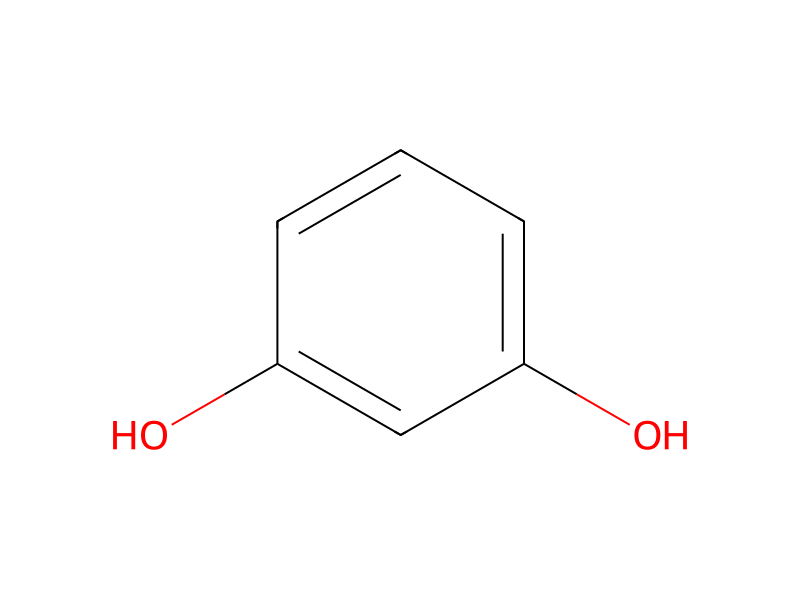


Product 1

Reagents, catalysts & solvents 1

Procedure
To a solution of (E)-methyl 2-(2-(bromomethyl)phenyl)-3-methoxyacrylate (0.5 g, 1.7 mmol) and 3-hydroxyphenol (0.2 g, 2.1 mmol) in 20 mL of acetonitrile (CH3CN) was added potassium carbonate (0.35 g, 2.6 mmol). The reaction mixture was stirred under reflux and concentrated in a vacuum to remove the solvent. The residue was stirred in water (20 mL) and the aqueous layer was extracted twice with 20 mL of dichloromethane. The organic layer was dried over anhydrous magnesium sulfate and concentrated in a vacuum to remove the solvent. The concentrate was purified by silica gel chromatography to afford (E)-methyl 2-(2-((3-hydroxyphenoxy)methyl)phenyl)-3-methoxyacrylate as a white solid (0.4 g, yield 74%).
Workup
- temperatureunder reflux
- concentrationconcentrated in a vacuum
- customto remove the solvent
- stirringThe residue was stirred in water (20 mL)
- extractionthe aqueous layer was extracted twice with 20 mL of dichloromethane
- dry with materialThe organic layer was dried over anhydrous magnesium sulfate
- concentrationconcentrated in a vacuum
- customto remove the solvent
- customThe concentrate was purified by silica gel chromatography
Sources & evidence
- ORD record
- ord-56006303c5814305825516104f211c52
- Source dataset
- uspto-grants-2014_07
- Patent number
- US08772290B2
Reaction notes
Loading…