Iodoethane → HCID 58574191, compound
Reaction equation

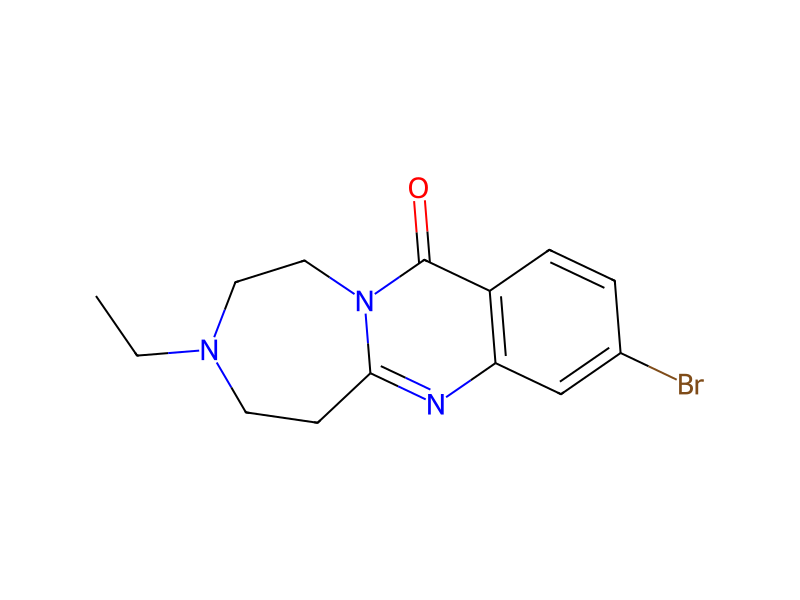
[Br:1][C:2]1[CH:3]=[CH:4][C:5]2[C:6](=[O:17])[N:7]3[CH2:16][CH2:15][NH:14][CH2:13][CH2:12][C:8]3=[N:9][C:10]=2[CH:11]=1.C([O-])([O-])=O.[K+].[K+].I[CH2:25][CH3:26]>CC(C)=O.O>[Br:1][C:2]1[CH:3]=[CH:4][C:5]2[C:6](=[O:17])[N:7]3[CH2:16][CH2:15][N:14]([CH2:25][CH3:26])[CH2:13][CH2:12][C:8]3=[N:9][C:10]=2[CH:11]=1Participants
6
Reactant 3



Product 1
Reagents, catalysts & solvents 2


Procedure
A solution of 8-bromo-2,3,4,5-tetrahydro-[1,4]diazepino[7,1-b]quinazolin-11(1H)-one (100 mg, 0.34 mmol), K2CO3 (188 mg, 1.36 mmol) and excess iodoethane in acetone (20 mL) was stirred at room temperature overnight. Then the reaction mixture was diluted with water (80 mL) and extracted with ethyl acetate (3×70 mL). The combined organic layers were dried over Na2SO4. After filtration and concentration, the residue was purified by silica gel chromatography to give 100 mg of the desired product. MS (ESI): 322, 324 (MH+).
Workup
- extractionextracted with ethyl acetate (3×70 mL)
- dry with materialThe combined organic layers were dried over Na2SO4
- filtrationAfter filtration and concentration
- customthe residue was purified by silica gel chromatography
Sources & evidence
- ORD record
- ord-11a4edaa07f84ed8b7c394963e5392ad
- Source dataset
- uspto-grants-2014_07
- Patent number
- US08772301B2
Reaction notes
Loading…