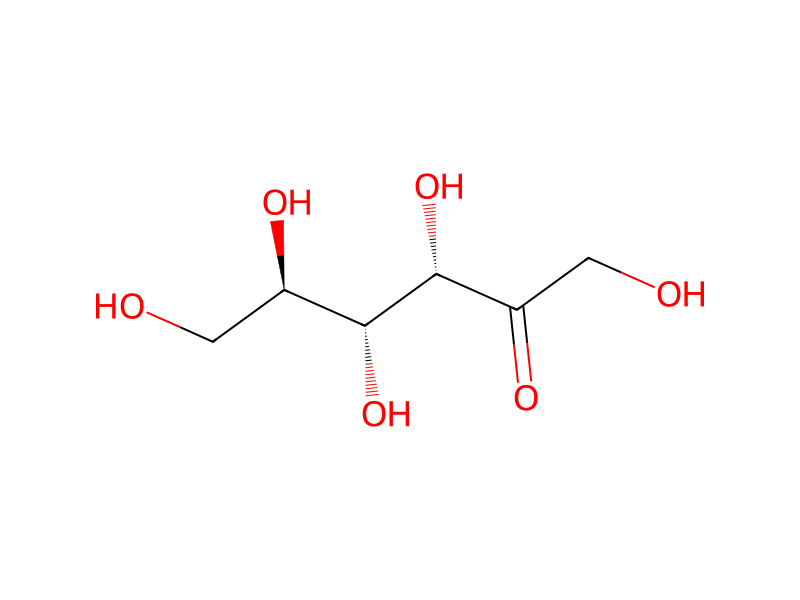
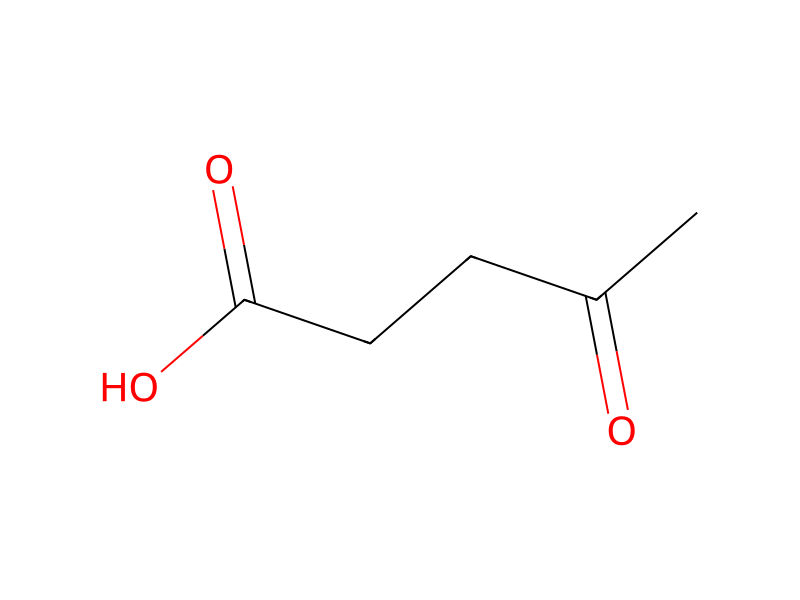
D-(-)-Fructose → Gamma-Valerolactone
Reaction equation

[OH:1][CH2:2][C:3]([C@H:5]([C@@H:7]([C@@H:9](CO)O)[OH:8])O)=O.O=C[C@@H:15]([C@H:17]([C@@H:19]([C@@H:21]([CH2:23][OH:24])O)O)[OH:18])O>>[C:2]1(=[O:1])[O:8][CH:7]([CH3:9])[CH2:5][CH2:3]1.[C:23]([OH:24])(=[O:1])[CH2:21][CH2:19][C:17]([CH3:15])=[O:18]Participants


Procedure
While glucose is obtained from cellulose in quantitative yield (98-100%), glucose isomerization to fructose is economically limited to roughly 42% [17]. As a consequence, the market price of fructose is often twice as high as the market price of glucose. Thus, the production of HMF from glucose instead of fructose is a more cost-effect process. Herein is disclosed and claimed an integrated process using solid acid catalysts and biomass-derived solvents, γ-lactones, hydrofurans and hydropyrans for converting glucose to HMF. Optionally, the HMF so formed may be upgrading by hydrogenation or oxidation. As depicted in Reaction Scheme 2, below, γ-valerolactone (GVL) can be obtained from hydrogenation of levulinic acid, another platform molecule derived from monosaccharide dehydration. In addition, GVL is an important platform molecule used for the production of chemicals and fuels.[21, 22] Other γ-lactones with higher molecular weights can be obtained from GVL, as described elsewhere,[23, 24] or by ring closing of unsaturated acid.[25] Thus, in addition to using GVL, the Examples below also disclose reactions using γ-hexylactone (GHL), γ-octalactone (GOL) and γ-undecalactone (GUL). Similar to GVL, THF can be derived from biomass from the decarbonylation and hydrogenation of furfural, a product of xylose dehydration.[26, 27]
Workup
- customOptionally, the HMF so formed may
- customAs depicted in Reaction Scheme 2
Sources & evidence
- ORD record
- ord-36c2a7fd49324dc7be07426bad1844e5
- Source dataset
- uspto-grants-2014_07
- Patent number
- US08772515B2
Reaction notes
Loading…