Hydrazine hydrate (1:1) → 6-Bromo-1-methylindolin-2-one
Reaction equation

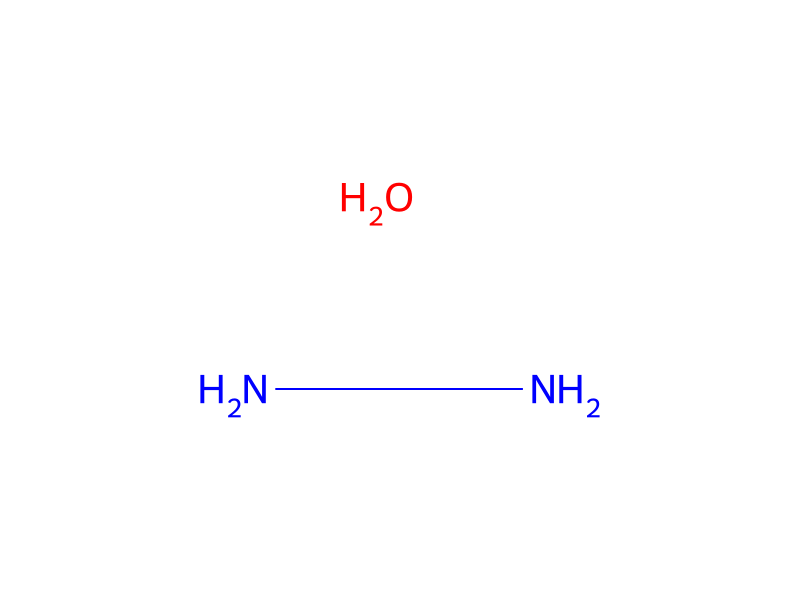
[Br:1][C:2]1[CH:10]=[C:9]2[C:5]([C:6](=O)[C:7](=[O:12])[N:8]2[CH3:11])=[CH:4][CH:3]=1.O.NN>ClCCl.O>[Br:1][C:2]1[CH:10]=[C:9]2[C:5]([CH2:6][C:7](=[O:12])[N:8]2[CH3:11])=[CH:4][CH:3]=1Participants
Reactant 2

Product 1

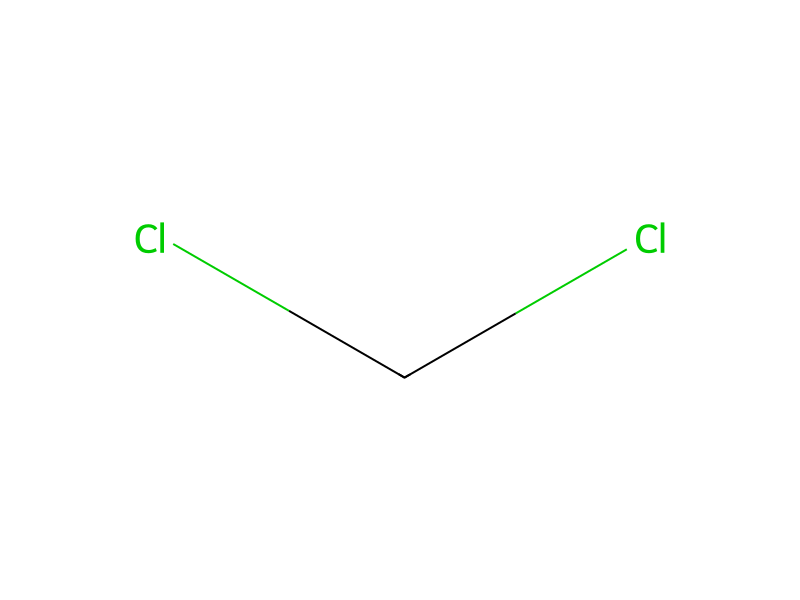
Reagents, catalysts & solvents 2
Conditions
- Temperature
- 130 °C
Procedure
To a solution of 6-bromoisatin (CAS#6326-79-0, 4.52 g, 20.0 mmol) in acetonitrile (150 mL) was added potassium carbonate (11.1 g, 80 mmol) followed by iodomethane (2.75 mL, 44.0 mind). The reaction was then placed at 60° C. and stirred for 40 minutes. The reaction was then cooled to room temperature, filtered and concentrated to 10% of the original volume. The reaction was then diluted with dichloromethane, water, and brine. The layers were separated and the aqueous layer was extracted two additional times with dichloromethane. The organic extracts were combined, dried over anhydrous sodium sulfate filtered and concentrated to provide 6-bromo-1-methyl-1H-indole-2,3-dione as an orange solid without the need for further purification. The 6-bromo-1-methyl-1H-indole-2,3-dione (1.0 g, 4.2 mmol) was then treated with hydrazine hydrate (7.0 mL, 225 mmol). The reaction was heated to 130° C. and stirred for 80 minutes, at which time the reaction was placed at room temperature and cooled by the addition of ice. Once the reaction was cooled to room temperature it was diluted with dichloromethane and water and the layers were separated. The aqueous layer was extracted an additional two times with dichloromethane, and the organic layers were combined, dried over anhydrous sodium sulfate, filtered and concentrated. The resulting residue was purified by silica gel flash chromatography (ethanol-dichloromethane 0 to 2%) to afford 6-bromo-1-methyl-1,3-dihydro-indol-2-one; MS: (ES+) m/z 225.9 (M+H)+.
Workup
- customfor further purification
- customwas placed at room temperature
- temperaturecooled by the addition of ice
- temperatureOnce the reaction was cooled to room temperature it
- customthe layers were separated
- extractionThe aqueous layer was extracted an additional two times with dichloromethane
- dry with materialdried over anhydrous sodium sulfate
- filtrationfiltered
- concentrationconcentrated
- customThe resulting residue was purified by silica gel flash chromatography (ethanol-dichloromethane 0 to 2%)
Sources & evidence
- ORD record
- ord-a94347e17a1044a58a7b8a36eff3935d
- Source dataset
- uspto-grants-2014_07
- Patent number
- US08778972B2
Reaction notes
Loading…