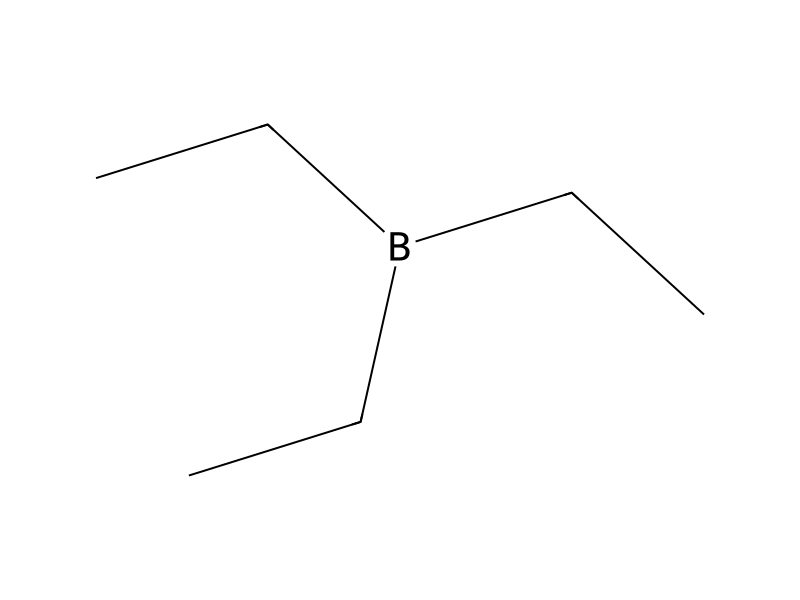
Triethylborane → HCID 67078613, compound
Reaction equation

C(=O)([O-])[O-].[K+].[K+].C(B([CH2:12][CH3:13])CC)C.[Br:14][C:15]1[C:16](I)=[C:17]2[CH:23]=[CH:22][N:21]([S:24]([C:27]3[CH:32]=[CH:31][C:30]([CH3:33])=[CH:29][CH:28]=3)(=[O:26])=[O:25])[C:18]2=[N:19][CH:20]=1>CN(C)C=O>[Br:14][C:15]1[C:16]([CH2:12][CH3:13])=[C:17]2[CH:23]=[CH:22][N:21]([S:24]([C:27]3[CH:32]=[CH:31][C:30]([CH3:33])=[CH:29][CH:28]=3)(=[O:25])=[O:26])[C:18]2=[N:19][CH:20]=1Participants
Reactant 3


Product 1

Reagents, catalysts & solvents 1

Conditions
- Temperature
- 80 °C
Procedure
A [1,1′-bis(diphenylphosphino)ferrocene]palladium(II) chloride-dichloromethane complex (26 mg), potassium carbonate (130 mg) and triethylborane (1 M solution in hexane) (0.75 ml) were added to a solution of the compound obtained in Step 1 of Example 122 (300 mg) in N,N-dimethylformamide (12 ml). The mixture was stirred under nitrogen atmosphere at 80° C. for 24 hours. The reaction solution was cooled to room temperature and then separated by adding ethyl acetate and distilled water. The resulting organic layer was washed with brine and dried over anhydrous sodium sulfate. The solvent was evaporated under reduced pressure. The resulting residue was purified by silica gel column chromatography (developed with ethyl acetate-hexane) to give the title compound (147 mg).
Workup
- temperatureThe reaction solution was cooled to room temperature
- customseparated
- additionby adding ethyl acetate
- distillationdistilled water
- washThe resulting organic layer was washed with brine
- dry with materialdried over anhydrous sodium sulfate
- customThe solvent was evaporated under reduced pressure
- customThe resulting residue was purified by silica gel column chromatography (developed with ethyl acetate-hexane)
Sources & evidence
- ORD record
- ord-2fdc0ea5cbde45908f24d4debc24c443
- Source dataset
- uspto-grants-2014_07
- Patent number
- US08785438B2
Reaction notes
Loading…