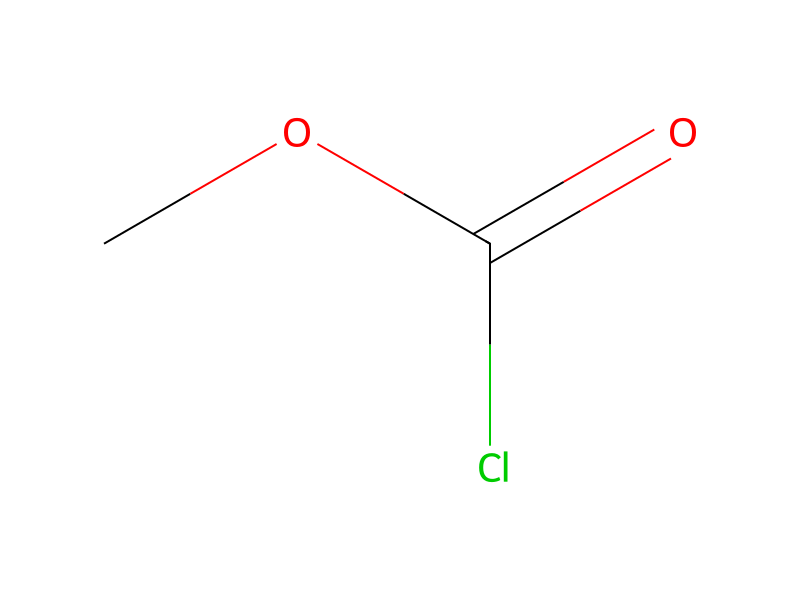
Methyl chloroformate → methyl 2-chloro-4-morpholino-5H-pyrrolo[3,4-d]pyrimidine-6(7H)-carboxylate
Reaction equation

FC(F)(F)C(O)=O.[Cl:8][C:9]1[N:10]=[C:11]([N:18]2[CH2:23][CH2:22][O:21][CH2:20][CH2:19]2)[C:12]2[CH2:17][NH:16][CH2:15][C:13]=2[N:14]=1.CCN(CC)CC.[CH3:31][O:32][C:33](Cl)=[O:34].[OH-].[Na+]>CN(C=O)C>[Cl:8][C:9]1[N:10]=[C:11]([N:18]2[CH2:19][CH2:20][O:21][CH2:22][CH2:23]2)[C:12]2[CH2:17][N:16]([C:33]([O:32][CH3:31])=[O:34])[CH2:15][C:13]=2[N:14]=1Participants
6
Reactant 4



Product 1

Reagents, catalysts & solvents 1

Conditions
- Temperature
- 20 °C
Procedure
To a stirring solution of 4-(2-chloro-6,7-dihydro-5H-pyrrolo[3,4-d]pyrimidin-4-yl)morpholine trifluoroacetate (intermediate 20) (2.16 g, 2.0 mmol) in DMF (10 ml), was added Et3N (560 uL, 4.0 mmol). Reaction mixture was stirred at room temperature (20° C.) for 2 minutes followed by the addition of methylchloroformate (186 uL, 2.4 mmol) followed by stirring at room temperature overnight. The reaction mixture was basified (with 2M NaOH) before partitioning between water (25 ml) and DCM (50 ml). The organic layer was recovered, passed through a hydrophobic frit and the solvent removed in vacuo, affording the title compound as a brown solid used without further purification.
Workup
- customReaction mixture
- stirringby stirring at room temperature overnight
- custombefore partitioning between water (25 ml) and DCM (50 ml)
- customThe organic layer was recovered
- customthe solvent removed in vacuo
Sources & evidence
- ORD record
- ord-43855ddbb17246edba0d1364d4cc62dd
- Source dataset
- uspto-grants-2014_07
- Patent number
- US08785457B2
Reaction notes
Loading…