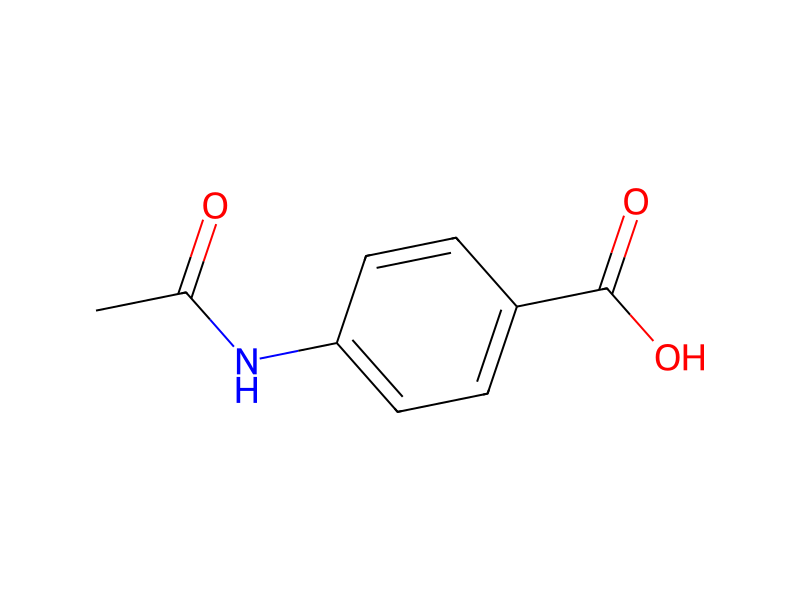
p-Acetamidobenzoic acid → 4-Acetamidobenzoyl chloride
Reaction equation

ClC1C=C(C2C(OC)=CC=C([C:16]([C:18]3[CH:23]=[CH:22][C:21]([NH:24][C:25](=[O:27])[CH3:26])=[CH:20][CH:19]=3)=[O:17])C=2F)C=CC=1.C(NC1C=CC(C(O)=O)=CC=1)(=O)C.O=S(Cl)[Cl:44]>C1COCC1.CN(C=O)C>[C:25]([NH:24][C:21]1[CH:22]=[CH:23][C:18]([C:16]([Cl:44])=[O:17])=[CH:19][CH:20]=1)(=[O:27])[CH3:26]Participants
6
Reactant 3


Product 1

Reagents, catalysts & solvents 2


Procedure
Synthesis of N-[4-(3′-chloro-2-fluoro-6-methoxy-biphenyl-3-carbonyl)-phenyl]-acetamide (I-19, R1═CH3, R2═Cl, Y═F, R3=4-acetylaminophenyl): To a stirred suspension of 4-acetylaminobenzoic acid (Aldrich, 1.32 g, 5.58 mmol) in anhydrous THF (20 mL) was added SOCl2 (1.19 g, 10.04 mmol) and DMF (4 drops). The reaction mixture was stirred at room temperature for 3 h, concentrated under vacuum to afford 4-acetylaminobenzoyl chloride (I-18, R3=4-acetylaminophenyl) as a light yellow solid.
Workup
- concentrationconcentrated under vacuum
Sources & evidence
- ORD record
- ord-51a74179546840fc8ea93abfaaa69918
- Source dataset
- uspto-grants-2014_07
- Patent number
- US08791267B2
Reaction notes
Loading…