Molybdenum → Molybdenum oxide
Reaction equation

[NH3:1].N.N.N.N.N.[OH2:7].O.O.O.O.O.O.O.O.O.O.O.O.O.O.O.O.O.O.O.O.O.O.O.[Mo:31].[Mo].[Mo].[Mo].[Mo].[Mo].[Mo].[P]=O.[Mo].[P]>OP(O)(O)=O.O.[NH4+].[NH4+].[O-][Mo]([O-])(=O)=O>[NH3:1].[NH3:1].[NH3:1].[NH3:1].[NH3:1].[NH3:1].[OH2:7].[OH2:7].[OH2:7].[OH2:7].[OH2:7].[OH2:7].[OH2:7].[OH2:7].[OH2:7].[OH2:7].[OH2:7].[OH2:7].[OH2:7].[OH2:7].[OH2:7].[OH2:7].[OH2:7].[OH2:7].[OH2:7].[OH2:7].[OH2:7].[OH2:7].[OH2:7].[OH2:7].[Mo:31].[Mo:31].[Mo:31].[Mo:31].[Mo:31].[Mo:31].[Mo:31].[Mo:31]=[O:7]Participants
9
Reactant 4


Product 2

Reagents, catalysts & solvents 3


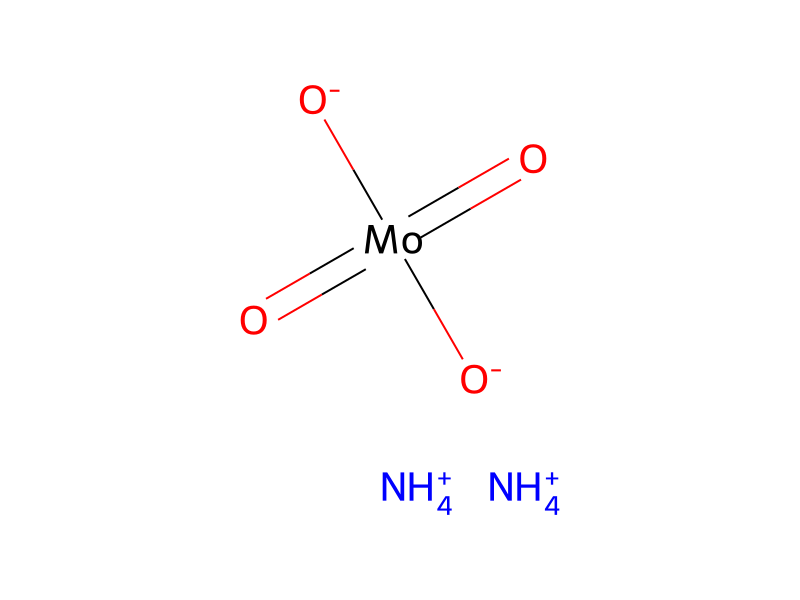
Procedure
A γ-alumina obtained as 1/16 inch extrudates from Criterion Catalyst Company L. P., Michigan City, Ind. was used. First, an ammonium heptamolybdate solution was prepared by dissolving (NH4)6Mo7O24 -4H2O in concentrated H3PO4 and water so that the ammonium molybdate concentration was 9.855 weight %, the H3PO4 concentration was 12.681 weight %, and water made up the rest. Then, 10 g of the alumina was impregnated at 25 ° C. with 5.32 g of the ammonium heptamolybdate solution to form a mixture. The mixture was then calcined in air at 538° C. for 6 hours to produce 10.18 g of a molybdenum oxide- and phosphorus oxide-impregnated alumina containing 2.807 weight % molybdenum and 2.096 weight % phosphorus (control catalyst).
Sources & evidence
- ORD record
- ord-5a94a6f0c0c44d8690d7134a8519cc52
- Source dataset
- uspto-grants-2000_03
- Patent number
- US06037302
Reaction notes
Loading…