Hydroquinone → 4-{[tert-Butyl(diphenyl)silyl]oxy}phenol
Reaction equation

[C:1]1([CH:8]=[CH:7][C:5]([OH:6])=[CH:4][CH:3]=1)[OH:2].N1C=CN=C1.[C:14]([Si:18]([C:26]1[CH:31]=[CH:30][CH:29]=[CH:28][CH:27]=1)([C:20]1[CH:25]=[CH:24][CH:23]=[CH:22][CH:21]=1)Cl)([CH3:17])([CH3:16])[CH3:15]>N1C=CC=CC=1>[Si:18]([O:2][C:1]1[CH:8]=[CH:7][C:5]([OH:6])=[CH:4][CH:3]=1)([C:14]([CH3:17])([CH3:16])[CH3:15])([C:26]1[CH:27]=[CH:28][CH:29]=[CH:30][CH:31]=1)[C:20]1[CH:25]=[CH:24][CH:23]=[CH:22][CH:21]=1Participants
5
Reactant 3


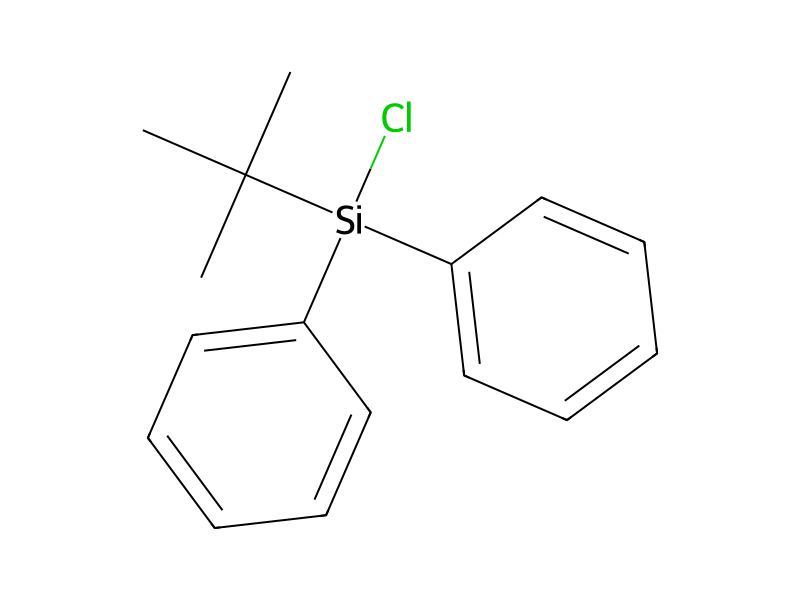
Product 1

Reagents, catalysts & solvents 1

Procedure
To a solution of 8.26 g of hydroquinone and 6.3 g of imidazole in 80 mL of pyridine was added 20.6 g of t-butyldiphenylchlorosilane in 20 mL of pyridine. After 1.5 h the mixture was partitioned between water and ethyl acetate. The organic layer was washed twice with phosphate buffer (pH 2) and once each with phosphate buffer (pH 8) and brine before being filtered through N/N/S and concentrated in vacuo. Preparative liquid chromatography [silica; hexane/ethyl acetate (85:15)] afforded 14.4 g of 4-(t-butyldiphenylsilyloxy)phenol. The structure was confirmed by its NMR spectrum.
Workup
- customAfter 1.5 h the mixture was partitioned between water and ethyl acetate
- washThe organic layer was washed twice with phosphate buffer (pH 2)
- filtrationonce each with phosphate buffer (pH 8) and brine before being filtered through N/N/S
- concentrationconcentrated in vacuo
Sources & evidence
- ORD record
- ord-7dbacf88637c4a87bcb536537b086313
- Source dataset
- uspto-grants-2000_03
- Patent number
- US06043270
Reaction notes
Loading…