Hydrochloric Acid → 2,6-Dichloro-4-nitrophenol
Reaction equation

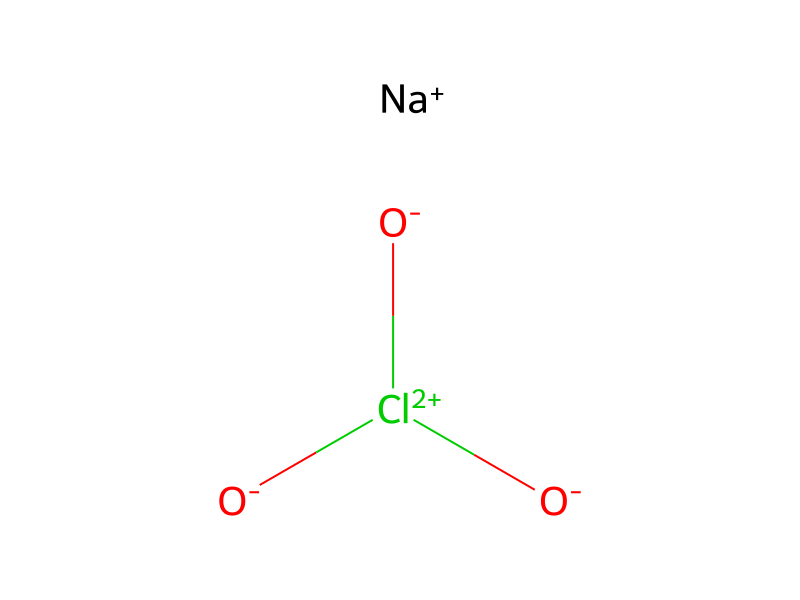
[CH:1]1[C:6]([N+:7]([O-:9])=[O:8])=[CH:5][CH:4]=[C:3]([OH:10])[CH:2]=1.Cl([O-])(=O)=O.[Na+].[ClH:16].[Cl:17]Cl>O>[Cl:16][C:4]1[CH:5]=[C:6]([N+:7]([O-:9])=[O:8])[CH:1]=[C:2]([Cl:17])[C:3]=1[OH:10]Participants
Reactant 4



Product 1

Reagents, catalysts & solvents 1

Procedure
139 part of p-nitrophenol are suspended in 200 parts of water and the suspension is ground. The finely particulate suspension of p-nitrophenol so obtained is then added simultaneously with 260 parts of a 33 % solution of sodium chlorate to 1250 parts of 33 % hydrochloric acid. The simultaneous addition of educt and chlorinating agent is made at a temperature of 25° C. and such that the sodium chlorate is added over 240 minutes and the p-nitrophenol for 20 minutes longer over 260 minutes. The batch is subsequently allowed to react for 30 minutes and residual chlorine is expelled over a further 30 minutes. Any chlorine still remaining is destroyed with sodium bisulfite. The product is then isolated by filtration, washed until neutral and dried, affording 199.5 parts of 2,6-dichloro-4-nitrophenol in 99.7 % purity. The yield is 95.6 %; melting point: 119°-120° C. (lit.: 125° C.). Analysis by gas chromatography shows that the product has the same retention time as authentic material.
Workup
- customso obtained
- additionThe simultaneous addition of educt and chlorinating agent
- additionis added over 240 minutes
- customto react for 30 minutes
- customAny chlorine still remaining is destroyed with sodium bisulfite
- customThe product is then isolated by filtration
- washwashed until neutral and
- customdried
Sources & evidence
- ORD record
- ord-c5a1be4a9d14474d93c40f011e9572c3
- Source dataset
- uspto-grants-1989_11
- Patent number
- US04879415
Reaction notes
Loading…