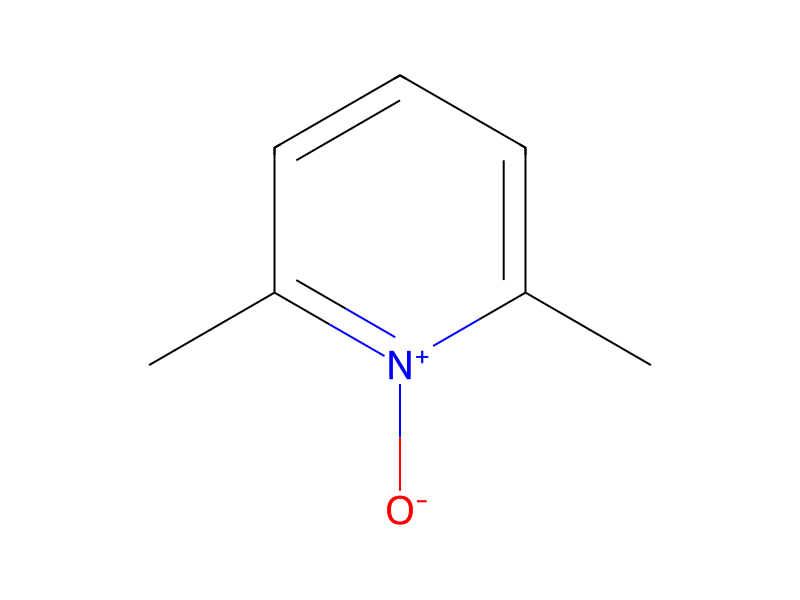
Hydrogen Peroxide → 2,6-Dimethylpyridine N-oxide
Reaction equation

[N:1]1[C:6]([CH3:7])=[CH:5][CH:4]=[CH:3][C:2]=1[CH3:8].[OH:9]O>C(O)(=O)C>[N+:1]1([O-:9])[C:6]([CH3:7])=[CH:5][CH:4]=[CH:3][C:2]=1[CH3:8]Participants
4
Reactant 2


Product 1
Reagents, catalysts & solvents 1

Procedure
A solution of 2,6-lutidine (19, 23 ml, 200 mmol) and 50% hydrogen peroxide (15 ml) in glacial acetic acid (100 ml) is refluxed at 110° C. for 3 hours. The solution is then concentrated in vacuo at 40° C. to approximately 60 ml. Water (20 ml) is added, and the concentration process is repeated three times. The concentrated solution is further dried by lyophilizer overnight, yielding 26 g of 2,6-Lutidine 1-oxide (20) that contains approximately 10% acetic acid. 1H NMR (300 MHz, CDCl3) δ 2.52 (s, 6H), 7.15 (m, 3H). MS, m/z 124 (M+1), 247 (2M+1).
Workup
- concentrationThe solution is then concentrated in vacuo at 40° C. to approximately 60 ml
- additionWater (20 ml) is added
- customThe concentrated solution is further dried by lyophilizer overnight
Sources & evidence
- ORD record
- ord-74fafa1d8f2d421d9db878c7f39a5775
- Source dataset
- uspto-grants-2012_02
- Patent number
- US08114888B2
Reaction notes
Loading…