L-Tryptophan → (2R,3S,4R,5R)-2,3,4,5,6-pentahydroxyhexanal
Reaction equation

C(O)[C@H]1[O:7][CH:6]([OH:8])[C@H:5]([OH:9])[C@@H:4](O)[C@@H]1O.O.C1C=C2C(C[C@H](N)C(O)=O)=CNC2=CC=1.[O:29]=[CH:30][C@@H:31]([C@H:33]([C@@H:35]([C@@H:37]([CH2:39][OH:40])[OH:38])[OH:36])[OH:34])[OH:32].C(O)[C@H]1O[C@H](OC[C@H]2OC(O)[C@H](O)[C@@H](O)[C@@H]2O)[C@H](O)[C@@H](O)[C@@H]1O>>[C:6]([O-:8])(=[O:7])[C@H:5]([CH3:4])[OH:9].[O:29]=[CH:30][C@@H:31]([C@H:33]([C@@H:35]([C@@H:37]([CH2:39][OH:40])[OH:38])[OH:36])[OH:34])[OH:32]Participants
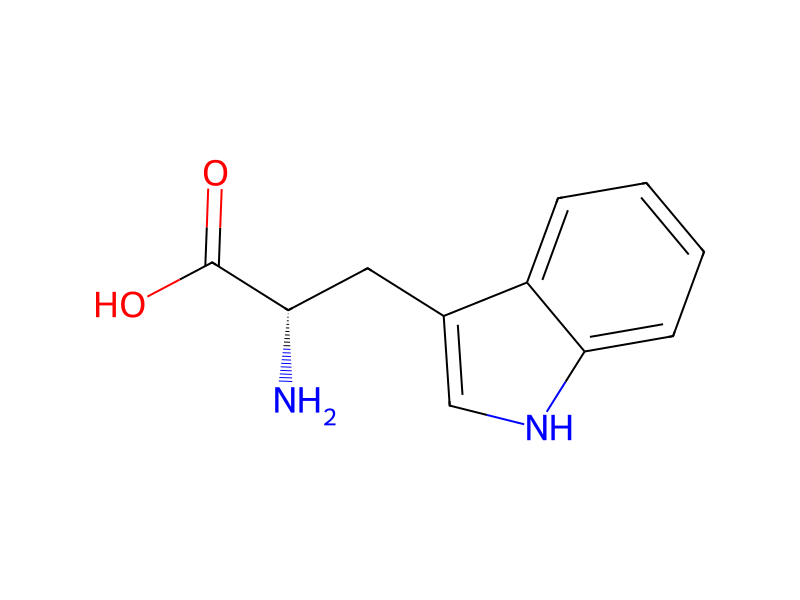
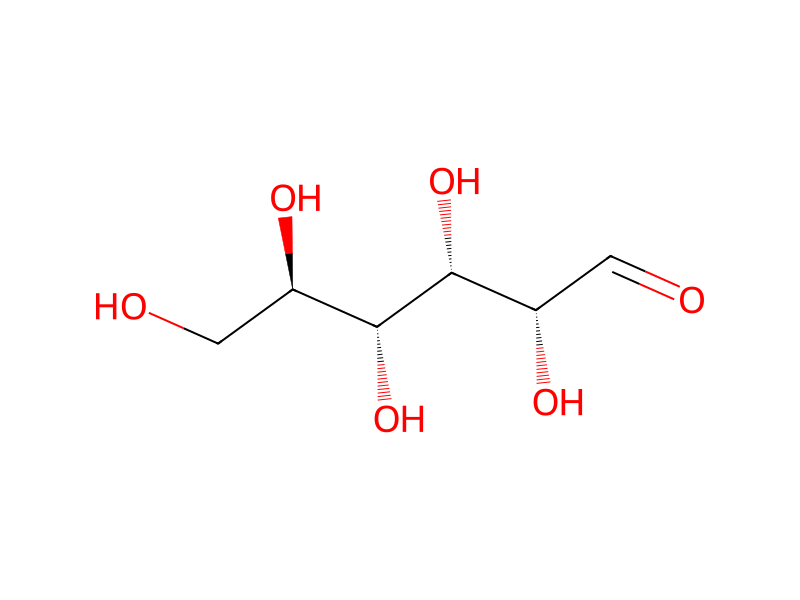


Procedure
The benchmark for the SSF fermentation was set by the fermentation with glucose syrup (DE 98) as substrate. The SSF study was started with a maltodextrine preparation from Roquette Freres (Glucidex™ 12, DE 11-14) and successfully finished. Two glucoamylase preparations were extensively tested: AMG E™ from Novozymes (glucoamylase with high debranching activity) and Optimax™ 7525 HP from Genencor (glucoamylase/pullulanase). A typical SSF fermentation on pure maltodextrines was free of residual sugars within 2 days. The main residual sugars present were glucose and isomaltose, however, at a consistently lower concentration than in comparable cultures that received DE 98 glucose syrup as substrate. Maltose concentrations were low (<50 mg/i) in contrast to comparable DE 98 cultures running at pH 6.4-6.6. A considerable amount of maltose was introduced in the fermentation with the addition of Glucidex 12. The fact that maltose could be fermented at low pH was a significant finding. The fermentation yield (mol (S)-lactate produced per mol glucose consumed) was slightly higher than 100%. Organic acids in sugar free SSF broth were analyzed and levels were comparable with Bacillus coagulans fermentations at pH 6.4-6.6. Below pH 5.55 the SSF fermentation was relatively slow. At pH 5.90 a 50% increase in total residual sugar was observed compared to cultures running between pH 5.55-5.75. Similar results were obtained using the crude liquefied starch. In the final stage, successful SSF experiments were performed with crude liquefied starch hydrolysates. There was no difference observed between the SSF fermentation on purified maltodextrines and the liquefied starch from the Cargill Refinery regarding fermentation time. Both SSF fermentations finished in 30-40 hours. Cultures containing crude liquefied starch or maltodextrin as substrate typically contained 180-200 g/l of (S)-lactic acid. The enantiomeric purity of the lactic acid was better than 99.5%.
Workup
- concentrationhowever, at a consistently lower concentration than in comparable cultures that
- concentrationMaltose concentrations
- additionA considerable amount of maltose was introduced in the fermentation with the addition of Glucidex 12
- customThe fermentation yield
Sources & evidence
- ORD record
- ord-09657f5611c546d59bb9d1dcbce3e36b
- Source dataset
- uspto-grants-2012_02
- Patent number
- US08119376B2
Reaction notes
Loading…