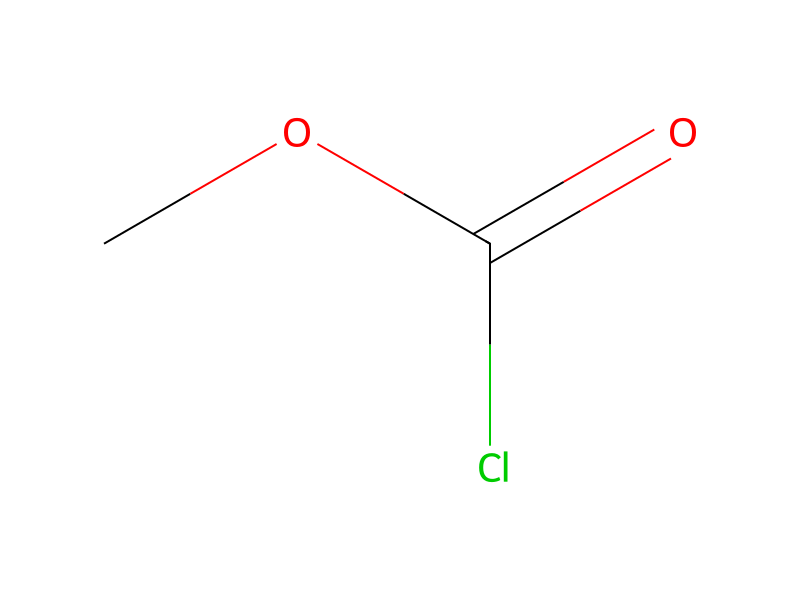
Methyl chloroformate → Dimethyl (2S)-5-oxopyrrolidine-1,2-dicarboxylate
Reaction equation

[NH:1]1[C@H:5]([C:6]([O:8][CH3:9])=[O:7])[CH2:4][CH2:3][C:2]1=[O:10].C[Si]([N-][Si](C)(C)C)(C)C.[Li+].Cl[C:22]([O:24][CH3:25])=[O:23]>O1CCCC1>[O:10]=[C:2]1[N:1]([C:22]([O:24][CH3:25])=[O:23])[C@H:5]([C:6]([O:8][CH3:9])=[O:7])[CH2:4][CH2:3]1Participants
Reactant 3


Product 1

Reagents, catalysts & solvents 1

Conditions
- Temperature
- -78 °C
Procedure
To a cold (−78° C.) solution of methyl (S)-(+)-2-pyrrolidone-5-carboxylate (4.80 grams, 33.5 mmol) in tetrahydrofuran (90 mL) was added a solution of lithium bis(trimethylsilyl) amide (1 M solution in hexanes, 40.0 mL, 40.0 mmol) dropwise via syringe over 15 minutes; then methyl chloroformate (2.90 mL, 36.9 mmol) was added dropwise via syringe over 5 minutes. The resulting slurry was stirred at −78° C. for 1 hour after which the reaction was quenched with 1 M HCl (50 mL). The mixture was allowed to come to room temperature, concentrated under reduced pressure and the residue partitioned between ethyl acetate (200 mL) and 1 M HCl (200 mL). The aqueous layer was extracted with ethyl acetate (2×200 mL) and the combined organic layers were dried (sodium sulfate), filtered, and concentrated to provide the titled compound. MS (DCI/NH3) m/e 202 (M+H)+; 1H NMR (300 MHz, CDCl3): δ ppm 4.70 (dd, 1H), 3.88 (s, 3H), 3.80 (s, 3H), 2.74-2.30 (m, 3H), 2.15-2.05 (m, 1H).
Workup
- customwas quenched with 1 M HCl (50 mL)
- customto come to room temperature
- concentrationconcentrated under reduced pressure
- customthe residue partitioned between ethyl acetate (200 mL) and 1 M HCl (200 mL)
- extractionThe aqueous layer was extracted with ethyl acetate (2×200 mL)
- dry with materialthe combined organic layers were dried (sodium sulfate)
- filtrationfiltered
- concentrationconcentrated
Sources & evidence
- ORD record
- ord-f41ac9ec7be04f0a86d6618b6b043c89
- Source dataset
- uspto-grants-2012_02
- Patent number
- US08119664B2
Reaction notes
Loading…