Potassium Chloride → Citrate
Reaction equation

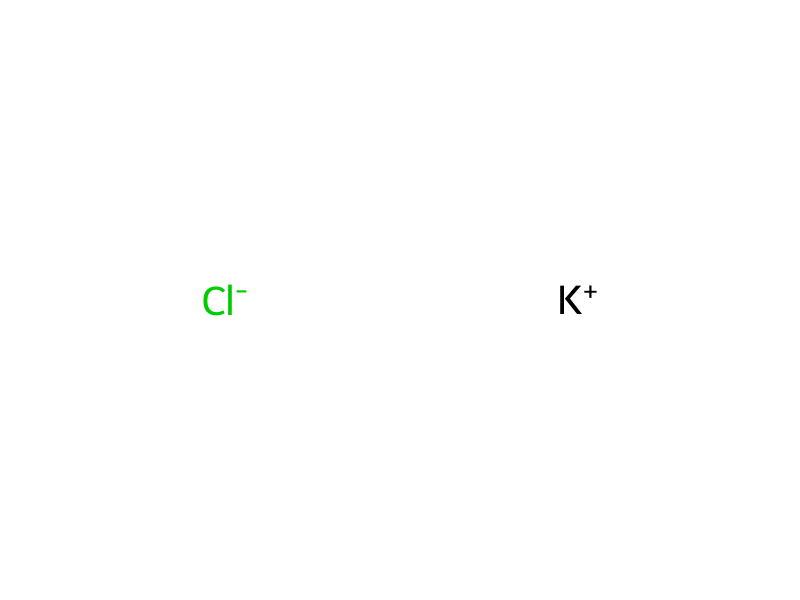
[Cl-].[K+].[C:3]([O-:15])(=[O:14])[CH2:4][C:5]([CH2:10][C:11]([O-:13])=[O:12])([C:7]([O-:9])=[O:8])[OH:6].[K+].[K+].[K+].C([O-])(=O)CC(CC([O-])=O)(C([O-])=O)O.[Mg+2:32].C([O-])(=O)CC(CC([O-])=O)(C([O-])=O)O.[Mg+2].[Mg+2].C([O-])(=O)CC(CC([O-])=O)(C([O-])=O)O.[Mg+2].[K+]>>[Mg:32].[C:3]([O-:15])(=[O:14])[CH2:4][C:5]([CH2:10][C:11]([O-:13])=[O:12])([C:7]([O-:9])=[O:8])[OH:6]Participants



Procedure
Each patient underwent five phases of study: placebo, potassium chloride, potassium citrate, magnesium citrate, and potassium-magnesium citrate. The results (mean values for the two patients) are outlined in Table 1. Compared to potassium chloride, potassium magnesium citrate gave a higher urinary pH, magnesium, and citrate. Compared to potassium citrate, potassium magnesium citrate produced a greater citrate excretion as well as enhanced magnesium excretion. Compared to magnesium citrate, potassium magnesium citrate gave higher values for urinary pH and citrate. Finally, compared to the placebo, potassium magnesium citrate produced higher values for urinary pH, magnesium, potassium and citrate, and lower values for urinary calcium and oxalate.
Workup
- customThe results (mean values for the two patients)
Sources & evidence
- ORD record
- ord-31f911edfb6a49f8bc44739dc4238953
- Source dataset
- uspto-grants-1995_07
- Patent number
- US05432200
Reaction notes
Loading…