Potassium Carbonate → 2-(4-Benzylpiperazin-1-yl)-6-fluorobenzaldehyde
Reaction equation

F[C:2]1[CH:9]=[CH:8][CH:7]=[C:6]([F:10])[C:3]=1[CH:4]=[O:5].[CH2:11]([N:18]1[CH2:23][CH2:22][NH:21][CH2:20][CH2:19]1)[C:12]1[CH:17]=[CH:16][CH:15]=[CH:14][CH:13]=1.C(=O)([O-])[O-].[K+].[K+]>CN(C)C=O>[F:10][C:6]1[CH:7]=[CH:8][CH:9]=[C:2]([N:21]2[CH2:22][CH2:23][N:18]([CH2:11][C:12]3[CH:13]=[CH:14][CH:15]=[CH:16][CH:17]=3)[CH2:19][CH2:20]2)[C:3]=1[CH:4]=[O:5]Participants
Reactant 3

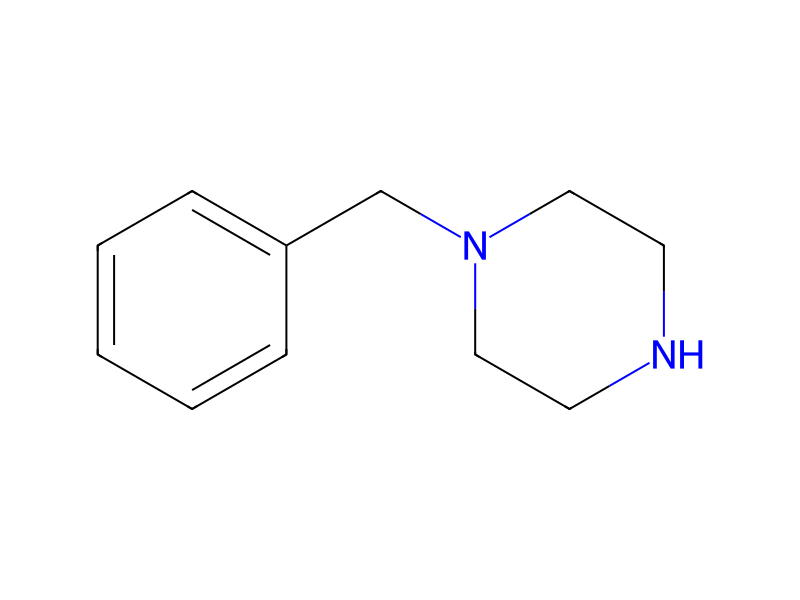

Product 1

Reagents, catalysts & solvents 1

Procedure
Combine 2,6-difluorobenzaldehyde (5.00 g, 35.2 mmol), 1-benzylpiperazine (7.30 mL, 42.2 mmol) and potassium carbonate (5.83 g, 42.2 mmol) in dry N,N-dimethylformamide (10 mL) under an atmosphere of nitrogen. Heat the reaction to 80° C. for 4 hours. Cool the reaction to room temperature (20° C.) and stir overnight. Quench the reaction with water (100 mL) and extract with ethyl acetate (3×100 mL). Combine the organic extracts, wash with saturated ammonium chloride (4×100 mL), dry over anhydrous magnesium sulfate/sodium sulfate, filter and concentrate under vacuum to provide the crude product as a yellow oil. Purify the crude material by flash chromatography (ethyl acetate:hexane, 30:70, TLC Rf =0.40) followed by recrystallization from hot ethyl acetate (50 mL). Collect the crystals by suction filtration and rinse with hexane to yield 5.16 g. Concentrate the mother liquor and recrystallize the solid from ethyl acetate (15 mL). Isolate the crystals as above to yield 1.71 g. Repeat the above process to yield an additional 0.95 g. This provides the 2-fluoro-6-[4-benzylpiperazin-1-yl]-benzaldehyde (7.82 g) as yellow crystals, mp 94°-95° C.; 1H NMR (CDCl3) δ 10.26 (1H,-s), 7.44 (1H, td, J=8.1, 6.3 Hz). 7.34 (4H, m), 7.29 (1H, m), 6.84 (1H, d, J=8.3 Hz), 6.74 (1H, dd, J=8.3, 8.0 Hz), 3.59 (2H, s), 3.12 (4H, m), 2.66 (4H, m); 13C NMR (CDCl3) δ 187.63, 187.56, 165.73, 162.27, 155.82, 137.82, 135.62, 135.46, 129.20, 128.27, 127.18, 116.91, 116.82, 114.26, 114.22, 109.38, 109.09, 62.95, 53.51, 52.96; 19F NMR CDCl3) δ -115.94 (m); IR (KBr) 2825, 1690, 1607, 1462, 1005 cm-1 ; EI/MS (70eV) 298(80%), 91(100%).
Workup
- temperatureHeat
- customthe reaction to 80° C. for 4 hours
- temperatureCool
- customthe reaction to room temperature (20° C.)
- customQuench
- customthe reaction with water (100 mL)
- extractionextract with ethyl acetate (3×100 mL)
- washCombine the organic extracts, wash with saturated ammonium chloride (4×100 mL)
- dry with materialdry over anhydrous magnesium sulfate/sodium sulfate
- filtrationfilter
- concentrationconcentrate under vacuum
- customto provide the crude product as a yellow oil
- customPurify the crude material by flash chromatography (ethyl acetate:hexane, 30:70, TLC Rf =0.40)
- customfollowed by recrystallization from hot ethyl acetate (50 mL)
- customCollect the crystals
- filtrationby suction filtration
- washrinse with hexane
- customto yield 5.16 g
- concentrationConcentrate the mother liquor
- customrecrystallize the solid from ethyl acetate (15 mL)
- customIsolate the crystals as above
- customto yield 1.71 g
- customRepeat the above process to yield an additional 0.95 g
Sources & evidence
- ORD record
- ord-eb4556f0071c4322a8c51b0e4049c51e
- Source dataset
- uspto-grants-1995_07
- Patent number
- US05436246
Reaction notes
Loading…