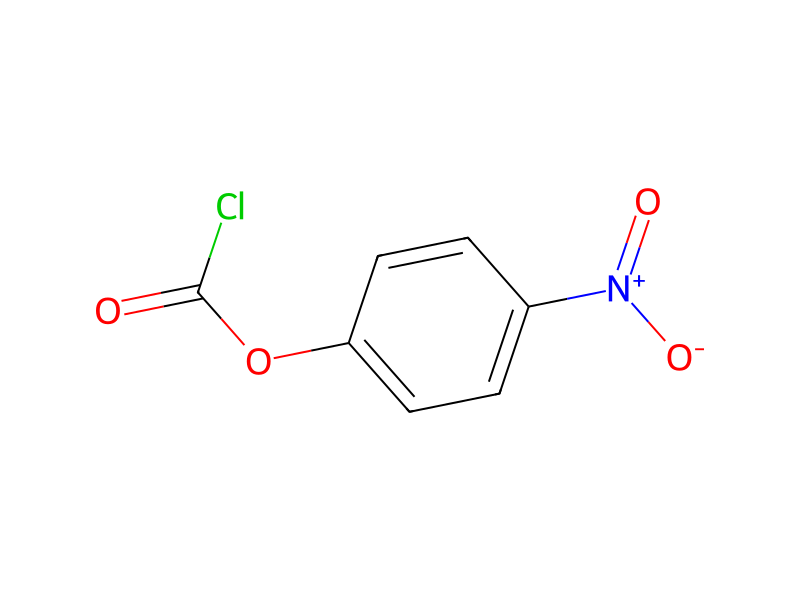
4-Nitrophenyl chloroformate → HCID 12805029, compound
Reaction equation

[NH2:1][C:2]1[CH:7]=[CH:6][C:5]([C:8]2[CH:9]([CH3:15])[CH2:10][C:11](=[O:14])[NH:12][N:13]=2)=[CH:4][CH:3]=1.Cl[C:17]([O:19][C:20]1[CH:25]=[CH:24][C:23]([N+:26]([O-:28])=[O:27])=[CH:22][CH:21]=1)=[O:18]>O1CCCC1>[CH3:15][CH:9]1[C:8]([C:5]2[CH:6]=[CH:7][C:2]([NH:1][C:17]([O:19][C:20]3[CH:21]=[CH:22][C:23]([N+:26]([O-:28])=[O:27])=[CH:24][CH:25]=3)=[O:18])=[CH:3][CH:4]=2)=[N:13][NH:12][C:11](=[O:14])[CH2:10]1Participants
4
Reactant 2

Product 1

Reagents, catalysts & solvents 1

Conditions
- Temperature
- 60 °C
Procedure
5.0 g (24.6 millimoles) of 6-(p-aminophenyl)-4,5-dihydro-5-methyl-3(2H)-pyridazinone are dissolved in 150 ml of absolute tetrahydrofuran by heating to 60° C., with stirring. The solution is allowed to cool to room temperature, 5.0 g (24.8 millimoles) of p-nitrophenyl chloroformate are added and the mixture is stirred first for 20 hours at room temperature and then for 5 hours under reflux. It is then concentrated to about 70 ml, 100 ml of water are added and the product is filtered off and recrystallized from dimethylformamide/water at room temperature, giving 6.5 g (72% of theory) of 4,5-dihydro-5-methyl-6-[p-(p-nitrophenoxycarbonylamino)-phenyl]-3(2H)-pyridazinone as yellow crystals, of melting point 177°-178° C.
Workup
- temperatureto cool to room temperature
- stirringthe mixture is stirred first for 20 hours at room temperature
- temperaturefor 5 hours under reflux
- concentrationIt is then concentrated to about 70 ml, 100 ml of water
- additionare added
- filtrationthe product is filtered off
- customrecrystallized from dimethylformamide/water at room temperature
Sources & evidence
- ORD record
- ord-3b55970b2bb04ae9a236b73ec8afc6ab
- Source dataset
- uspto-grants-1983_11
- Patent number
- US04415571
Reaction notes
Loading…