Hydrochloric Acid → (6R-trans)-7-Amino-3-(hydroxymethyl)-8-oxo-5-thia-1-azabicyclo(4.2.0)oct-2-ene-2-carboxylic acid
Reaction equation

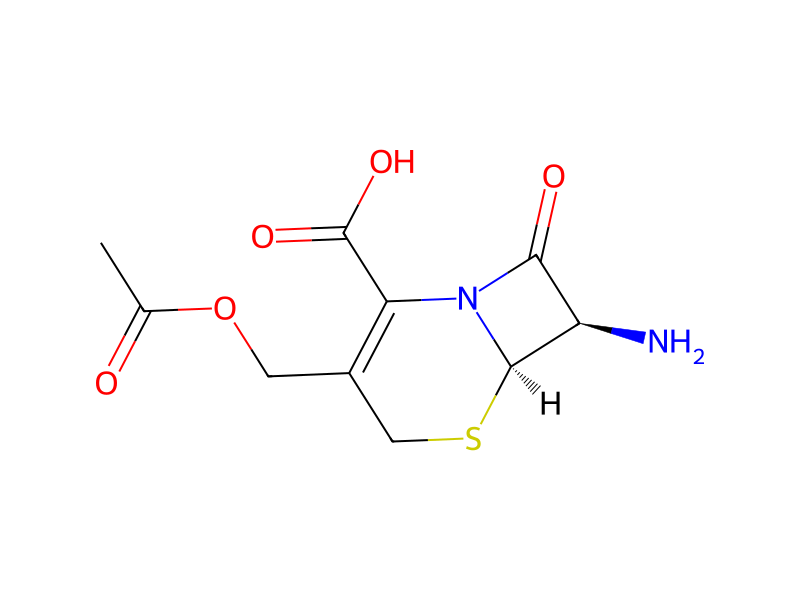
CC([O:4][CH2:5][C:6]1[CH2:15][S:14][C@@H:9]2[C@H:10]([NH2:13])[C:11](=[O:12])[N:8]2[C:7]=1[C:16]([OH:18])=[O:17])=O.[OH-].[Na+].Cl>O>[NH2:13][C@@H:10]1[C:11](=[O:12])[N:8]2[C:7]([C:16]([OH:18])=[O:17])=[C:6]([CH2:5][OH:4])[CH2:15][S:14][C@H:9]12Participants
5




Procedure
In 100 ml of water is suspended 10 g of 7-aminocephalosporanic acid (briefly, 7-ACA), and with ice-cooling and stirring, 2N-aqueous sodium hydroxide solution is added gradually to maintain the pH at 12.5 to 13.4. After about 2 hours of stirring, the reaction mixture is assayed by TLC and after confirming the disappearance of the starting material (7-ACA), the reaction mixture is adjusted to pH 3.4 with 4N-hydrochloric acid. The crystals that separate out are collected by filtration, washed with water and acetone, and dried in vacuo over phosphorus pentoxide to give 5.4 g light yellow crystals of 7β-amino-3-hydroxymethyl-3-cephem-4-carboxylic acid.
Workup
- temperaturecooling
- temperatureto maintain the pH at 12.5 to 13.4
- stirringAfter about 2 hours of stirring
- customThe crystals that separate out
- filtrationare collected by filtration
- washwashed with water and acetone
- dry with materialdried in vacuo over phosphorus pentoxide
Sources & evidence
- ORD record
- ord-9feb5043d753417e9b3302f9a0866d7c
- Source dataset
- uspto-grants-1990_05
- Patent number
- US04921851
Reaction notes
Loading…