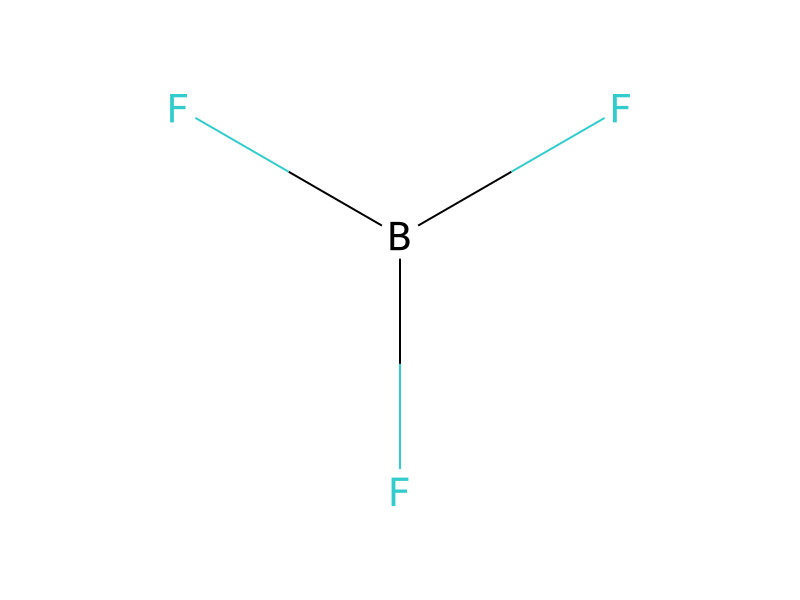
Boron trifluoride → [4-(4-Fluorobenzoyl)phenyl]-(4-fluorophenyl)methanone
Reaction equation

[C:1](Cl)(=[O:11])[C:2]1[CH:10]=[CH:9][C:5]([C:6](Cl)=[O:7])=[CH:4][CH:3]=1.[F:13][C:14]1[CH:19]=[CH:18][CH:17]=[CH:16][CH:15]=1.[FH:20].B(F)(F)F>>[F:13][C:14]1[CH:19]=[CH:18][C:17]([C:1]([C:2]2[CH:10]=[CH:9][C:5]([C:6](=[O:7])[C:2]3[CH:10]=[CH:9][C:5]([F:20])=[CH:4][CH:3]=3)=[CH:4][CH:3]=2)=[O:11])=[CH:16][CH:15]=1Participants
5



Procedure
20.3 g of terephthaloyl dichloride, 19.2 g of fluorobenzene and 50 g of hydrogen fluoride were initially introduced into a 250 ml stainless steel autoclave and boron trifluoride was introduced under pressure at 10 bar. The autoclave was shaken for 16.5 h at room temperature. Working-up was carried out by initially evaporating the volatile components at room temperature and then at 60° to 100° C. and recrystallizing the residue from chlorobenzene in the presence of sodium carbonate. 19.76 g of 1,4-bis-(4-fluorobenzoyl)-benzene were obtained in the form of colorless crystals of m.p. 221° C. Examination by means of high pressure liquid chromatography (HPLC) gave a degree of purity of 99.5%.
Workup
- additionwas introduced under pressure at 10 bar
- customby initially evaporating the volatile components at room temperature
- customat 60° to 100° C. and recrystallizing the residue from chlorobenzene in the presence of sodium carbonate
Sources & evidence
- ORD record
- ord-02cb75b589704f51b7d314d24a3b86e8
- Source dataset
- uspto-grants-1990_05
- Patent number
- US04924014
Reaction notes
Loading…