Pyridine → HCID 67794269, compound
Reaction equation
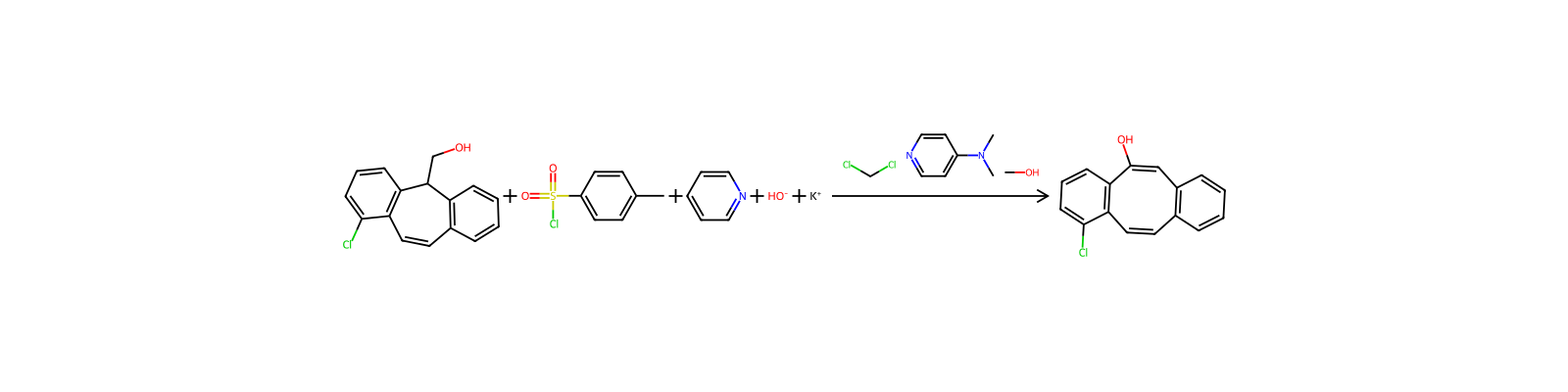
[Cl:1][C:2]1[C:12]2[CH:11]=[CH:10][C:9]3[CH:13]=[CH:14][CH:15]=[CH:16][C:8]=3[CH:7]([CH2:17][OH:18])[C:6]=2[CH:5]=[CH:4][CH:3]=1.C1(C)C=CC(S(Cl)(=O)=O)=CC=1.N1C=CC=CC=1.[OH-].[K+]>ClCCl.CN(C)C1C=CN=CC=1.CO>[Cl:1][C:2]1[C:12]2[CH:11]=[CH:10][C:9]3[CH:13]=[CH:14][CH:15]=[CH:16][C:8]=3[CH:7]=[C:17]([OH:18])[C:6]=2[CH:5]=[CH:4][CH:3]=1Participants
Reactant 4




Product 1

Reagents, catalysts & solvents 3



Procedure
To a solution of 1-chloro-5-hydroxymethyl-dibenzo [a,d]cycloheptene (8.3 g) in dichloromethane (80 ml) was added p-toluenesulphonyl chloride (6.3 g), pyridine (5.11 g), and 4-dimethylamino pyridine (150 mg). The reaction mixture was refluxed for 15h, cooled washed with water (2×80 ml), dried (Na2SO4), filtered and concentrated in vacuo to leave an oil which was purified by chromatography on flash silica with 15% ethyl acetate in hexane as eluent. The purified tosylate was dissolved in glacial acetic acid (100 ml) with anhydrous sodium acetate (4.4 g) and the solution refluxed for 15h. The mixture was concentrated in vacuo to leave a residue which was partitioned between dichloromethane (3×100 ml) and water (100 ml). The combined organic layers were dried (Na2SO4), filtered and concentrated in vacuo to leave a residue which was dissolved in 75% aqueous methanol (160 ml) and treated at 0° C. with potassium hydroxide (10 g). After 14h the reaction mixture was concentrated in vacuo. Chromatography of the residue on flash silica with 15% ethyl acetate in hexane as eluent gave the less polar isomer, 1-chloro-5-hydroxydibenzo[a,e]cyclooctene (1.5 g), m.p. 158°-160° C. δ(360 MHz, CDCl3) 3.12 (1H, dd, J =1.51 and 10.2 Hz, CHAHB --CHOH), 3.63 (1H, dd, J=15.1 and 6.9 Hz, CHAHB --CHOH), 5.57 (1H, dd, J=10.2 and 6.9 Hz, CHAHB --CHOH), 6.74 (1H, d, J=11.9 Hz, ArCHD =CHE --Ar), 7.03 (1H, d, J=11.9 Hz, ArCHD =CHEAr) and 7.07-7.46 (7H, m, aromatics). m/e 256 (M+). i.r.(νmax, nujol) 3350-3100 cm-1 (br, OH). Found: C, 74.5; H, 5.1. C16H13C10 requires: C, 74.9; H, 5.1%. Further elution gave the more polar isomer, 1-chloro-6-hydroxy-dibenzo[a,e]cyclooctene (0.47 g), m.p. 144°-146° C. δ(360 MHz, CDCl3) 3.39 (2H, m, CH--CHOH), 5.13 (1H, m, CH2 --CHOH), 6.77 (1H, d, J=11.9 Hz, Ar--CHA =CHB), 7.02 (1H, d, J=11.9 Hz, ArCHA =CHB) and 7.07-7.38 (7H, m, aromatics). m/e 256 (M+). i.r (νmax, nujol) 3300-3100 cm-1 (br, OH). Found: C, 74.8; H, 5.2. C16H13C10 requires: C, 74.9; H, 5.1%.
Workup
- temperaturecooled
- washwashed with water (2×80 ml)
- dry with materialdried (Na2SO4)
- filtrationfiltered
- concentrationconcentrated in vacuo
- customto leave an oil which
- customwas purified by chromatography on flash silica with 15% ethyl acetate in hexane as eluent
- dissolutionThe purified tosylate was dissolved in glacial acetic acid (100 ml) with anhydrous sodium acetate (4.4 g)
- temperaturethe solution refluxed for 15h
- concentrationThe mixture was concentrated in vacuo
- customto leave a residue which
- customwas partitioned between dichloromethane (3×100 ml) and water (100 ml)
- dry with materialThe combined organic layers were dried (Na2SO4)
- filtrationfiltered
- concentrationconcentrated in vacuo
- customto leave a residue which
- concentrationAfter 14h the reaction mixture was concentrated in vacuo
Sources & evidence
- ORD record
- ord-5abfac9e72744f418d50a86ba46b16be
- Source dataset
- uspto-grants-1990_05
- Patent number
- US04927819
Reaction notes
Loading…