Hydrochloric Acid → HCID 176523459, compound
Reaction equation

[ClH:1].[NH2:2][C:3]([NH2:5])=[NH:4].[CH2:6]([N:10]=[C:11]=[N:12][CH2:13][CH2:14][CH2:15][CH3:16])[CH2:7][CH2:8][CH3:9].O.Cl>CO>[ClH:1].[CH2:13]([NH:12][C:11]([NH:4][C:3]([NH2:5])=[NH:2])=[N:10][CH2:6][CH2:7][CH2:8][CH3:9])[CH2:14][CH2:15][CH3:16]Participants
Reactant 4


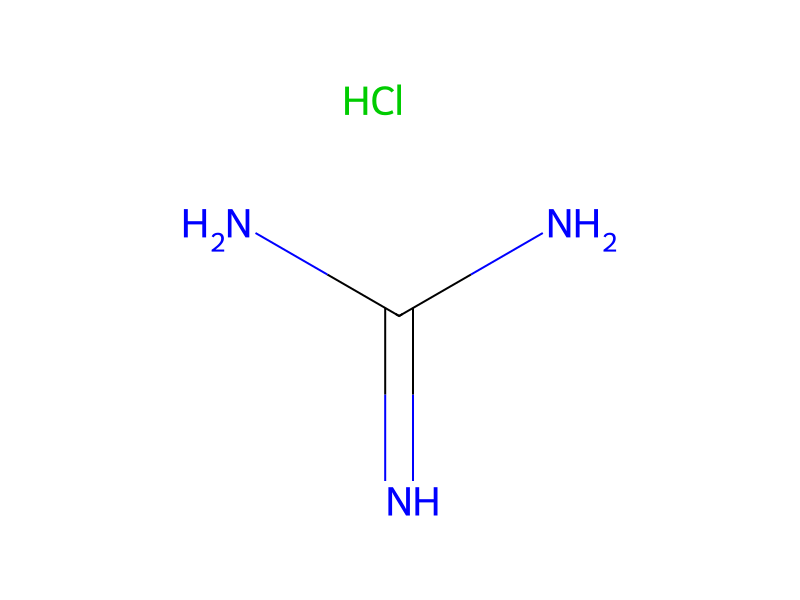

Product 1

Reagents, catalysts & solvents 1

Procedure
0.715 g. (7.5 mmol) of guanidine hydrochloride, 1.54 g. (10 mmol) of di-n-butyl carbodiimide, 5 ml. of water, and 15 ml. of methanol is heated for 16 hours under reflux. After evaporation, the oily residue is taken up in 15 ml. of water and extracted three times with respectively 20 ml. of ether in order to remove the 1,2-di-n-butyl urea formed as a by-product. The aqueous phase is mixed with concentrated hydrochloric acid to a pH of 4 and crystallizes during evaporation. The crude product having a melting point of 102°-105° C. is still contaminated by guanidine hydrochloride and minor amounts of 1,2-di-n-butyl urea. The product is suspended in dry chloroform, the remaining guanidine hydrochloride is filtered off, the chloroform solution is concentrated by evaporation, and the solid residue is recrystallized from acetonitrile.
Workup
- temperatureunder reflux
- customAfter evaporation
- extractionof water and extracted three times with respectively 20 ml
- customof ether in order to remove the 1,2-di-n-butyl urea
- customformed as a by-product
- customcrystallizes during evaporation
- filtrationthe remaining guanidine hydrochloride is filtered off
- concentrationthe chloroform solution is concentrated by evaporation
- customthe solid residue is recrystallized from acetonitrile
Sources & evidence
- ORD record
- ord-6abaf8f28d954c66bc0911cbe69ff8ff
- Source dataset
- uspto-grants-1976_06
- Patent number
- US03960949
Reaction notes
Loading…