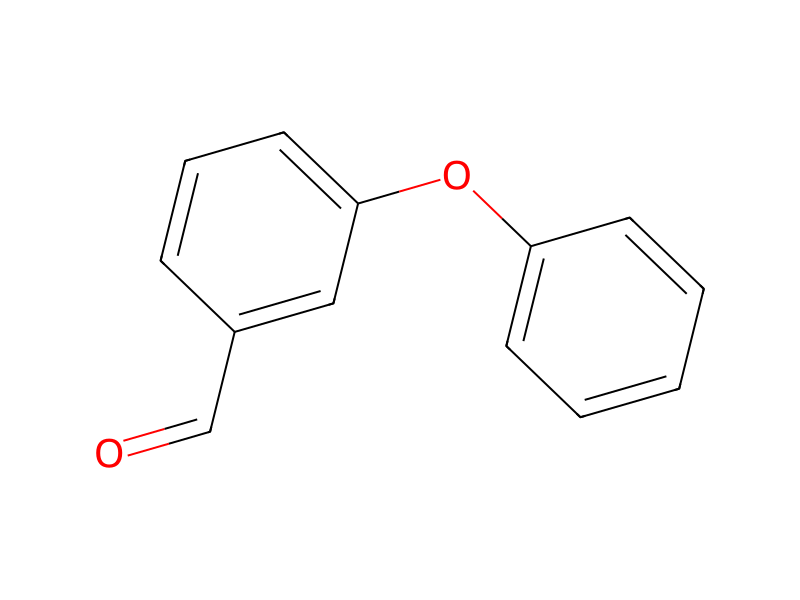
Water → 3-Phenoxybenzaldehyde
Reaction equation

[O:1]([C:8]1[CH:9]=[C:10]([CH:14]2OCC[O:15]2)[CH:11]=[CH:12][CH:13]=1)[C:2]1[CH:7]=[CH:6][CH:5]=[CH:4][CH:3]=1.S(=O)(=O)(O)O.O>C1(C)C(C)=CC=CC=1>[O:1]([C:8]1[CH:9]=[C:10]([CH:11]=[CH:12][CH:13]=1)[CH:14]=[O:15])[C:2]1[CH:3]=[CH:4][CH:5]=[CH:6][CH:7]=1Participants
5
Reactant 3



Product 1
Reagents, catalysts & solvents 1

Procedure
As a starting material a solution of crude 2-(3-phenoxyphenyl)-1,3-dioxolane obtained in Example 7 after neutralization is used. The solution in xylene is boiled with a mixture of 48 ml. of concentrated sulfuric acid and 530 ml. of water with stirring for 3 hours. Upon cooling the phases are separated. 211 g. (71%) of 3-phenoxybenzaldehyde are obtained, boiling at 128° to 130° C./0.4 mmHg. The yield is calculated for the starting material of Example 7. The purity of the obtained product is better than 95% (determined by gas chromatography);
Workup
- temperatureUpon cooling the phases
- customare separated
Sources & evidence
- ORD record
- ord-4965c31d57b44a2ab0f88dddddea8d03
- Source dataset
- uspto-grants-1981_12
- Patent number
- US04304938
Reaction notes
Loading…