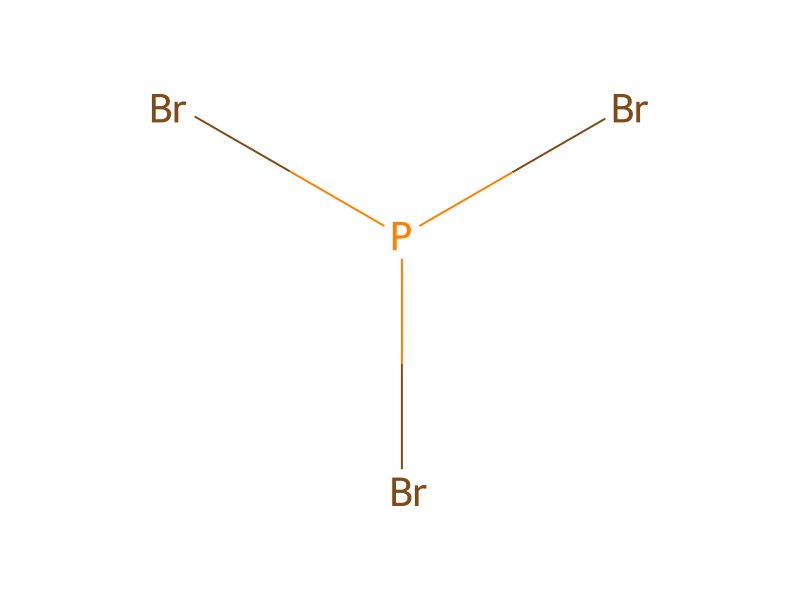
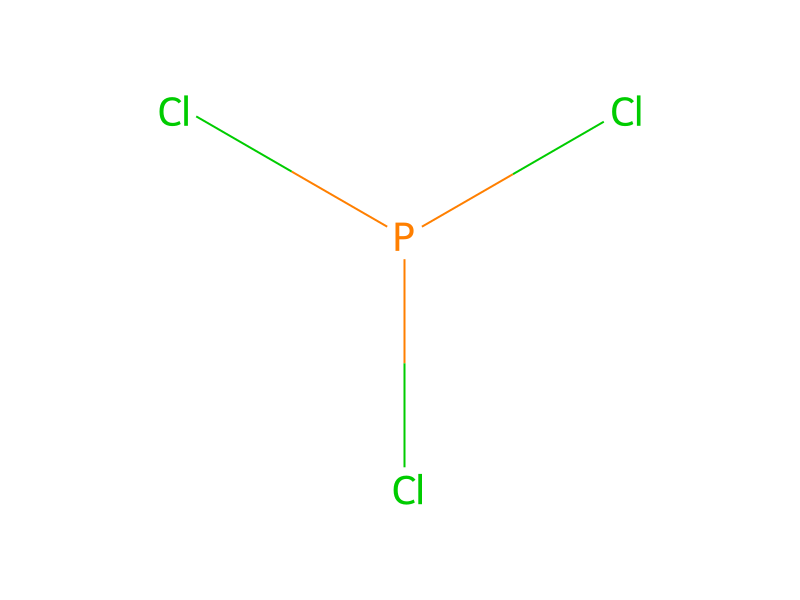
Phosphorus tribromide → Phosphorus trichloride
Reaction equation

[P:1]([Cl:5])([Cl:4])([Cl:3])=[O:2].P(Br)(Br)Br.[P:10]([Cl:15])([Cl:14])([Cl:13])([Cl:12])[Cl:11]>>[P:1]([Cl:5])([Cl:4])([Cl:3])=[O:2].[P:10]([Cl:13])([Cl:12])[Cl:11].[P:10]([Cl:15])([Cl:14])([Cl:13])([Cl:12])[Cl:11]Participants
6


Procedure
A number of dehydrating agents can be used, for example, phosphorus oxychloride, phosphorus tribromide, phosphorus pentachloride and polyphosphoric acid. Phosphorus oxychloride and phosphorus tribromide are the preferred agents. Furthermore, a particular dehydrating agent determines which compound of formula I will be formed: use of phosphorus oxychloride, phosphorus trichloride or phosphorus pentachloride affords the corresponding compound of formula I in which R5 is chloro; use of phosphorus oxybromide or phosphorus tribromide affords the corresponding compound of formula I in which R5 is bromo; and use of polyphosphoric acid affords the corresponding compound of formula I in which R5 is hydroxy.
Workup
- customwill be formed
Sources & evidence
- ORD record
- ord-7e355996d5ce44b1a4bbc521f2c8a182
- Source dataset
- uspto-grants-1981_12
- Patent number
- US04307234
Reaction notes
Loading…