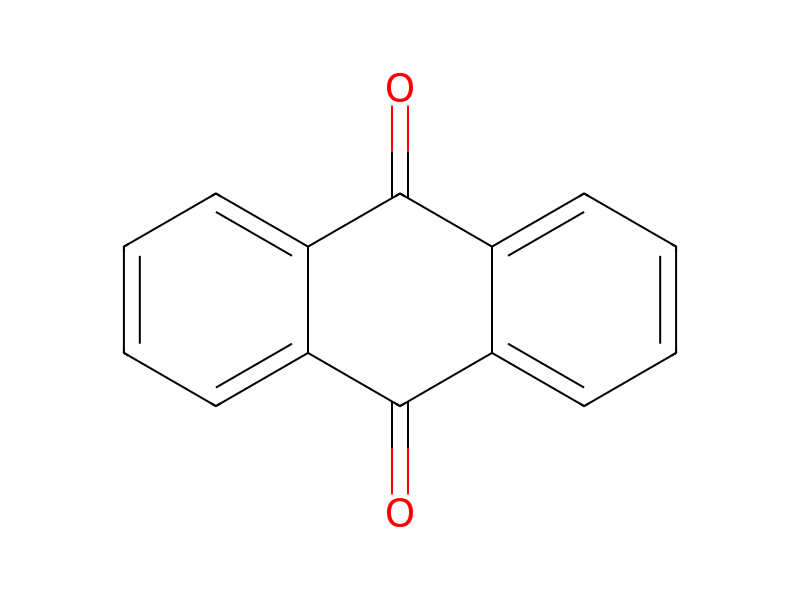
HCID 69971411, compound → Anthraquinone
Reaction equation

[CH2:1]1[CH:14]2[CH:5]([C:6](=[O:16])[CH:7]3[C:12]([C:13]2=[O:15])=[CH:11][CH2:10][CH2:9][CH2:8]3)[CH2:4][CH2:3][CH2:2]1.[H][H]>[Rh]>[CH:8]1[C:7]2[C:6](=[O:16])[C:5]3[C:14](=[CH:1][CH:2]=[CH:3][CH:4]=3)[C:13](=[O:15])[C:12]=2[CH:11]=[CH:10][CH:9]=1.[CH2:4]1[CH:5]2[CH:14]([C:13](=[O:15])[CH:12]3[C:7]([C:6]2=[O:16])=[CH:8][CH2:9][CH2:10][CH2:11]3)[CH2:1][CH2:2][CH2:3]1Participants
5
Reactant 2


Product 2
Reagents, catalysts & solvents 1
Procedure
The octahydro-anthraquinone (OHAQ) reaction is initially a highly exothermic and is immediately followed by the rapid elimination of hydrogen which has a pronounced cooling effect on the reaction system. Reaction times of less than 1 minute past the exotherm with a rhodium on carbon catalyst provided yields of 62 percent anthraquinone, along with isomerized OHAQ and isomerized THAQ. If the same reaction is conducted with palladium on a carbon support, a 75 percent yield of anthraquinone is obtained along with the isomerized OHAQ and isomerized THAQ. The reaction can be visualized to be the following: ##STR6##
Workup
- customprovided
Sources & evidence
- ORD record
- ord-ec4eec38a2e24f7e924c2da4599bad3e
- Source dataset
- uspto-grants-1981_12
- Patent number
- US04308211
Reaction notes
Loading…