Phenacyl bromide → Phenacyl thiocyanate
Reaction equation

Br[CH2:2][C:3]([C:5]1[CH:10]=[CH:9][CH:8]=[CH:7][CH:6]=1)=[O:4].[SiH4].[S-:12][C:13]#[N:14].[Na+]>C(O)C>[S:12]([CH2:2][C:3]([C:5]1[CH:10]=[CH:9][CH:8]=[CH:7][CH:6]=1)=[O:4])[C:13]#[N:14]Participants
5
Reactant 3
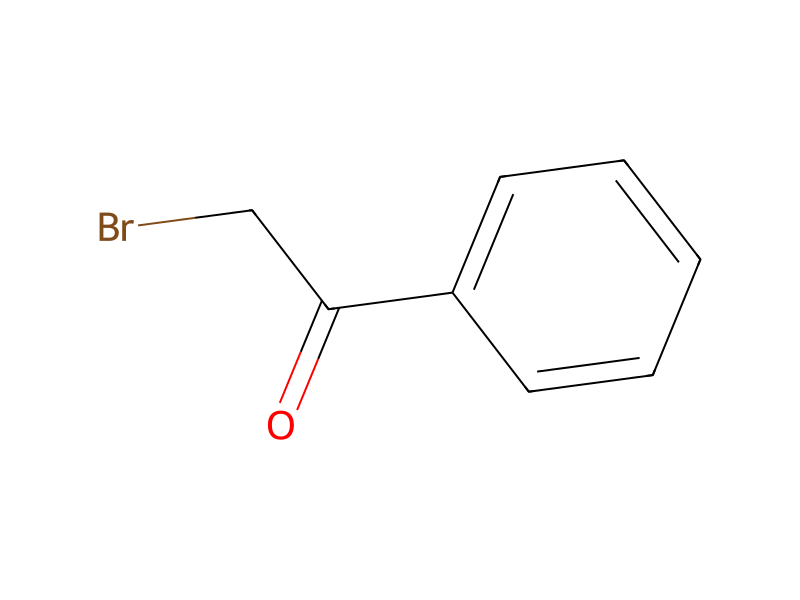


Product 1

Reagents, catalysts & solvents 1

Procedure
Bromoacetophenone-modified aminopropylsilylated glass surfaces (2.5×7.5 cm; Sigma, Silane-Prep™, S4651) (see Example 13) were coated with a 0.1M solution of sodium thiocyanate in ethanol and incubated for five hours at 50° C. The glass surfaces thus treated were then washed five times using respectively 30 mL of ethanol for 3 minutes each at room temperature. After washing three times for three minutes each using respectively 30 mL of DCM at room temperature, the glass surfaces were dried and stored at 4° C. until further use.
Workup
- additionThe glass surfaces thus treated
- washwere then washed five times
- customfor 3 minutes
- customat room temperature
- washAfter washing three times for three minutes each using respectively 30 mL of DCM at room temperature
- customthe glass surfaces were dried
- customstored at 4° C. until further use
Sources & evidence
- ORD record
- ord-6c69b8cd2f5d46608e9d805dbc1a368d
- Source dataset
- uspto-grants-2011_10
- Patent number
- US08029979B2
Reaction notes
Loading…