Acetonitrile → 3-(4-Chloro-2-fluorophenyl)-3-oxopropanenitrile
Reaction equation
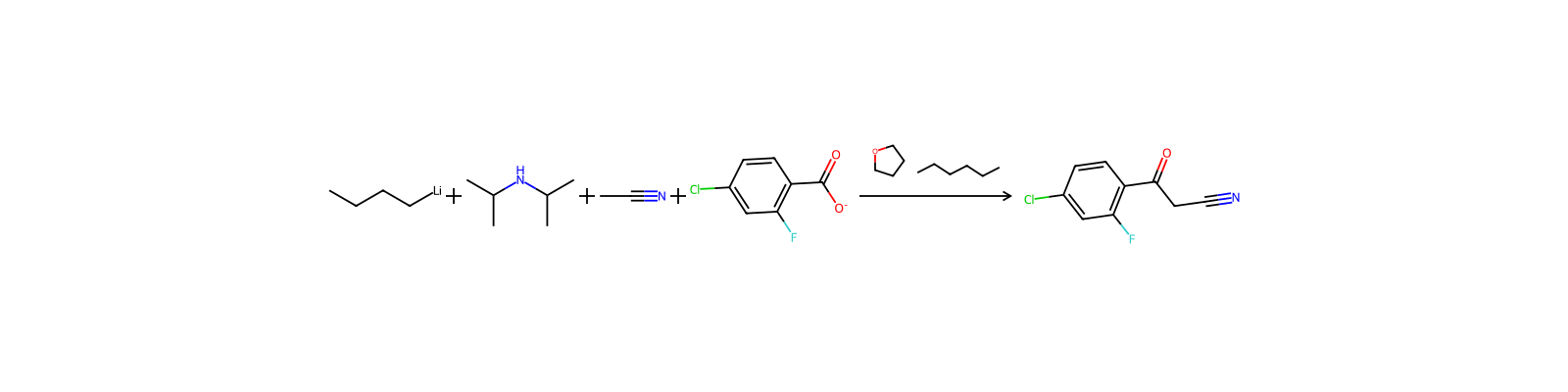
C([Li])CCC.C(NC(C)C)(C)C.[C:13](#[N:15])[CH3:14].[Cl:16][C:17]1[CH:25]=[CH:24][C:20]([C:21]([O-])=[O:22])=[C:19]([F:26])[CH:18]=1>C1COCC1.CCCCCC>[Cl:16][C:17]1[CH:25]=[CH:24][C:20]([C:21](=[O:22])[CH2:14][C:13]#[N:15])=[C:19]([F:26])[CH:18]=1Participants







Conditions
- Temperature
- -78 °C
Procedure
A 1.6 M hexane solution of n-butyllithium (39.8 mL, 63.6 mmol) was added to a solution of diisopropylamine (9.45 mL, 66.3 mmol) in THF (100 mL) at −78° C. over 10 min. The resultant solution was stirred at 0° C. for 30 min and cooled to −78° C. Acetonitrile (3.32 mL, 63.6 mmol) dropwise. The mixture was stirred at −78° C. for 30 min and then added a solution of 4-chloro-2-fluorobenzoate (5.00 g, 26.5 mmol) in THF (5 mL) at −78° C. dropwise. After stirring for 1 h at −78° C., the reaction mixture was quenched with brine (20 mL), warmed to room temperature and adjusted to pH 1-2 with 1N aqueous HCl. Following addition of ethyl acetate (400 mL), the mixture was washed with water (40 mL), brine (40 mL), dried (MgSO4) and concentrated to provide 3-(4-chloro-2-fluorophenyl)-3-oxopropanenitrile as tan solid (5.10 g, 97%). MS (ES+) m/z: 198 (M+H).
Workup
- stirringAfter stirring for 1 h at −78° C.
- customthe reaction mixture was quenched with brine (20 mL)
- temperaturewarmed to room temperature
- additionaddition of ethyl acetate (400 mL)
- washthe mixture was washed with water (40 mL), brine (40 mL)
- dry with materialdried (MgSO4)
- concentrationconcentrated
Sources & evidence
- ORD record
- ord-28419f3597464cb7b8b27c0509d7d643
- Source dataset
- uspto-grants-2011_10
- Patent number
- US08034940B2
Reaction notes
Loading…