2-Naphthyl isopropyl ketone → alpha-Bromoisopropyl 2-naphthyl ketone
Reaction equation
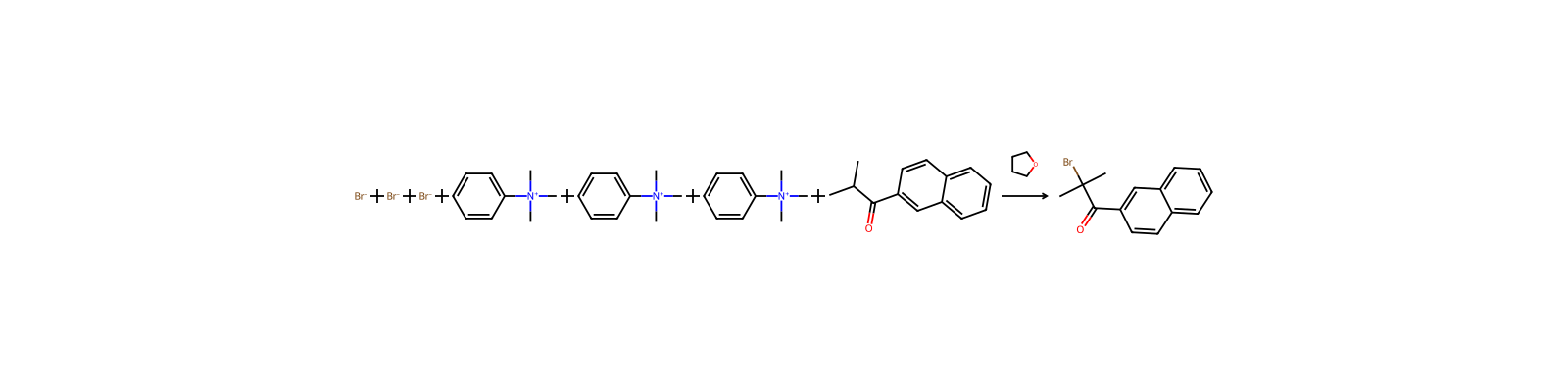
[Br-:1].[Br-].[Br-].C1([N+](C)(C)C)C=CC=CC=1.C1([N+](C)(C)C)C=CC=CC=1.C1([N+](C)(C)C)C=CC=CC=1.[CH:34]([C:37]([C:39]1[CH:48]=[CH:47][C:46]2[C:41](=[CH:42][CH:43]=[CH:44][CH:45]=2)[CH:40]=1)=[O:38])([CH3:36])[CH3:35]>O1CCCC1>[CH:40]1[C:41]2[C:46](=[CH:45][CH:44]=[CH:43][CH:42]=2)[CH:47]=[CH:48][C:39]=1[C:37]([C:34]([Br:1])([CH3:36])[CH3:35])=[O:38]Participants
4
Reactant 2


Product 1

Reagents, catalysts & solvents 1

Procedure
2.16 g of phenyltrimethylammonium tribromide was added to a mixture comprising 1.14 g of 2-naphthyl isopropyl ketone and 25 ml of tetrahydrofuran, and the mixture was reacted at room temperature for 3 hours. The reaction mixture was filtered, and the filtrate was concentrated under reduced pressure to obtain 1.59 g of oily α-bromoisopropyl 2-naphthyl ketone.
Workup
- customthe mixture was reacted at room temperature for 3 hours
- filtrationThe reaction mixture was filtered
- concentrationthe filtrate was concentrated under reduced pressure
Sources & evidence
- ORD record
- ord-8037e13c8f1c4a26a0fd6316a351b37f
- Source dataset
- uspto-grants-2011_10
- Patent number
- US08039420B2
Reaction notes
Loading…