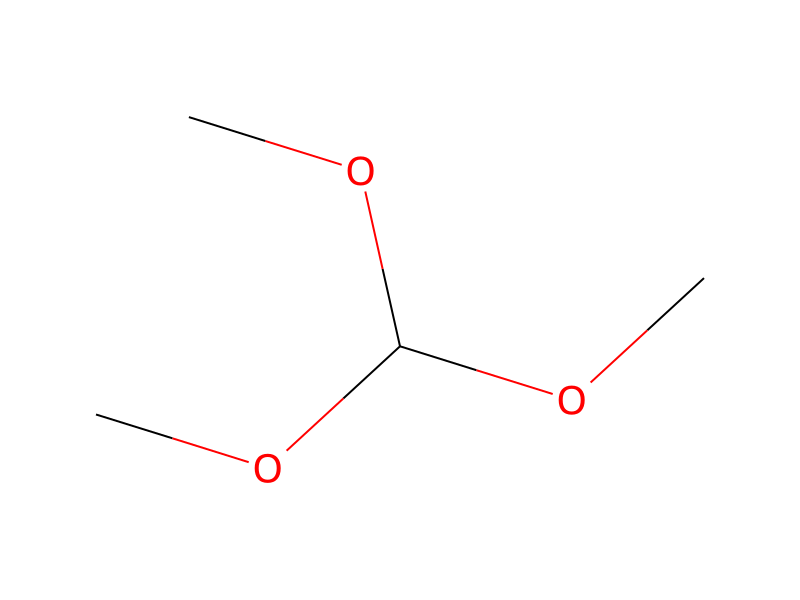
Trimethyl orthoformate → 4-Dimethoxymethyl-2-fluoro-1-nitrobenzene
Reaction equation

[F:1][C:2]1[CH:3]=[C:4]([CH:7]=[CH:8][C:9]=1[N+:10]([O-:12])=[O:11])C=O.[CH3:13][O:14][CH:15](OC)[O:16][CH3:17].O.C1(C)C=CC(S(O)(=O)=O)=CC=1.C(=O)(O)[O-].[Na+]>CO>[CH3:13][O:14][CH:15]([O:16][CH3:17])[C:4]1[CH:7]=[CH:8][C:9]([N+:10]([O-:12])=[O:11])=[C:2]([F:1])[CH:3]=1Participants
6




Procedure
A mixture of 0.5 g (2.96 mmole) of 3-fluoro-4-nitrobenzaldehyde, 1 mL of trimethylorthoformate, 0.020 g of p-toluenesulfonic acid monohydrate and 2 mL of methanol was heated at reflux for 1 hour. The mixture was cooled, and 1 mL of saturated aqueous sodium bicarbonate solution was added. The mixture was concentrated under reduced pressure, and the residue was partitioned between 30 mL of ethyl acetate and 30 mL of saturated aqueous sodium bicarbonate solution. The organic layer was washed with brine, dried over anhydrous magnesium sulfate, filtered and concentrated under reduced pressure to give 0.64 g of 4-dimethoxymethyl-2-fluoro-1-nitro-benzene (IV.2a) as a pale yellow oil. This material was used without further purification.
Workup
- temperaturewas heated
- temperatureat reflux for 1 hour
- temperatureThe mixture was cooled
- concentrationThe mixture was concentrated under reduced pressure
- customthe residue was partitioned between 30 mL of ethyl acetate and 30 mL of saturated aqueous sodium bicarbonate solution
- washThe organic layer was washed with brine
- dry with materialdried over anhydrous magnesium sulfate
- filtrationfiltered
- concentrationconcentrated under reduced pressure
Sources & evidence
- ORD record
- ord-911fb1f5ad1544f5adef44eb3f37e6ad
- Source dataset
- uspto-grants-2011_10
- Patent number
- US08044213B2
Reaction notes
Loading…