Sulfur tetrafluoride → Perfluoro-3-(butoxy)propene
Reaction equation

[F-:1].[K+].[F:3][C:4]([F:15])([C:11]([F:14])([F:13])[F:12])[C:5]([F:10])([F:9])[C:6]([F:8])=[O:7].S(F)(F)(F)F.S(F)(O[C:25]([F:32])([F:31])[C:26]([F:30])=[C:27]([F:29])[F:28])(=O)=O>COCCOCCOC>[F:28][C:27]([F:29])=[C:26]([F:30])[C:25]([F:32])([F:31])[O:7][C:6]([F:1])([F:8])[C:5]([F:10])([F:9])[C:4]([F:15])([F:3])[C:11]([F:12])([F:13])[F:14]Participants





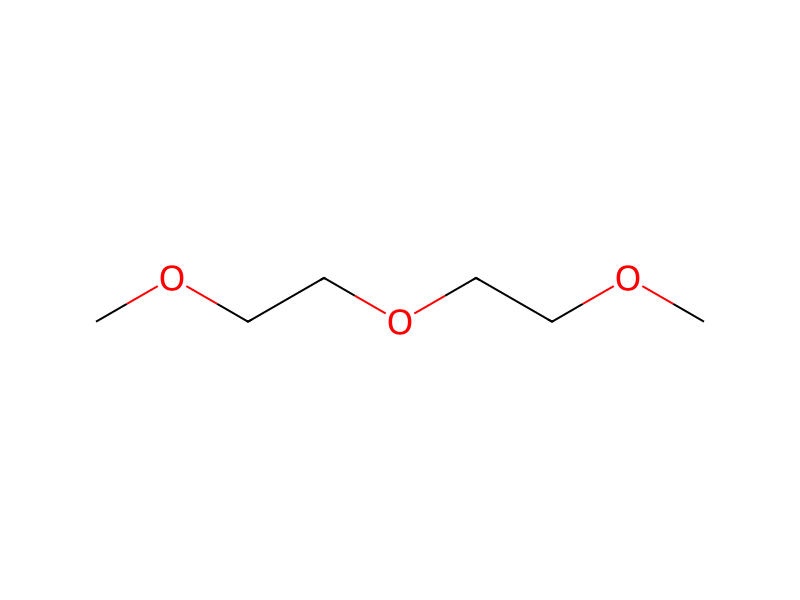
Conditions
- Temperature
- 5 °C
Procedure
A mixture of dry potassium fluoride (7.50 g, 0.13 mol), diglyme (100 ml) and heptafluorobutyroyl fluoride (prepared from the acid by treatment with sulfur tetrafluoride) (28.1 g, 0.13 mol) was stirred at 5° C. for 30 min. Perfluoroallyl fluorosulfate was added dropwise at 5° C., the mixture was stirred at this temperature for 1 hour, then at 25° C. for 3 hours. The volatile components were transferred by distillation at 40° C. (8 mm Hg), washed with water (100 ml), and distilled from a small amount of concentrated sulfuric acid to give perfluoro-3-(butoxy)propene (30.3 g, 0.083 mol, 64%) bp 80°-84° C. whose structure was confirmed by: λmax 5.57 (CF=CF2) and 7.2-9.5 μm (C--F, C--0); 19F NMR -72.1 (d J=25.2 Hz, each member t J=13.5 Hz, d J=13.5 Hz, d J=7.4 Hz) 2F, OCF2C=C, -82.1 (t J-8.1 Hz, each member m), 3F, CF3, -84.5 (m) 2F, CF2O, -92.1 (d J=52.3 Hz, each member d J=39.4 Hz, t J=7.4 Hz) 1F, cis-CF2CF=CF, -105.5 (d J=117.5 Hz, each member d J=52.3 Hz, t J=25.2 Hz) 1F, trans-CF2CF=CF, -127.3 (m) 4F, CF2, and -191.0 ppm (d J=117.5 Hz, each member d J=39.4 Hz, t J=13.7 Hz, m) 1F, CF2CF =C.
Workup
- stirringthe mixture was stirred at this temperature for 1 hour
- waitat 25° C. for 3 hours
- distillationThe volatile components were transferred by distillation at 40° C. (8 mm Hg)
- washwashed with water (100 ml)
- distillationdistilled from a small amount of concentrated sulfuric acid
Sources & evidence
- ORD record
- ord-4cc6acaa82fe4c3b887e79c30acd22b7
- Source dataset
- uspto-grants-1981_06
- Patent number
- US04275225
Reaction notes
Loading…