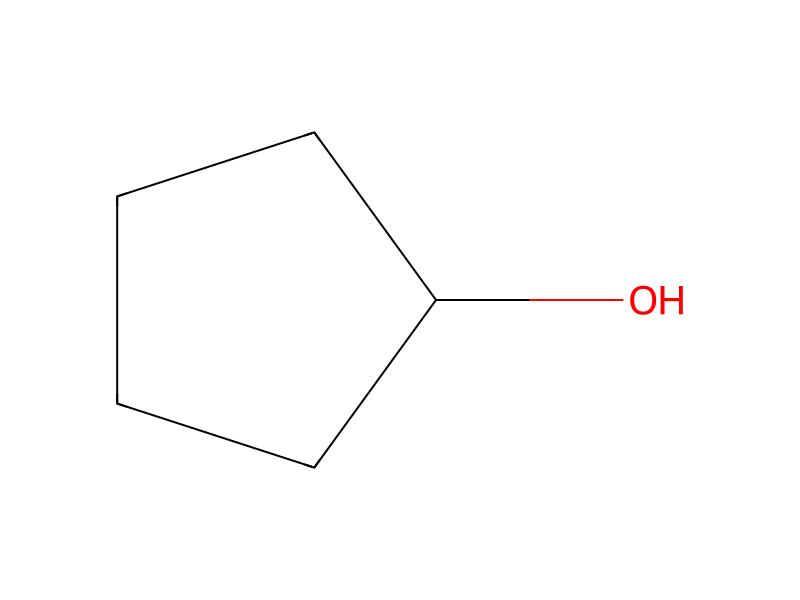
Cyclopentanol → Cyclopentyl 4-methylbenzene-1-sulfonate
Reaction equation

[CH:1]1([OH:6])[CH2:5][CH2:4][CH2:3][CH2:2]1.[C:7]1([CH3:17])[CH:12]=[CH:11][C:10]([S:13](Cl)(=[O:15])=[O:14])=[CH:9][CH:8]=1.[OH-].[K+]>CCOCC>[C:7]1([CH3:17])[CH:12]=[CH:11][C:10]([S:13]([O:6][CH:1]2[CH2:5][CH2:4][CH2:3][CH2:2]2)(=[O:15])=[O:14])=[CH:9][CH:8]=1Participants
5
Reactant 3


Product 1

Reagents, catalysts & solvents 1

Procedure
A round-bottomed flask (200 cc) was charged with cyclopentyl alcohol (10.0 g, 0.116 mol) and p-toluenesulfonyl chloride (24.3 g, 0.128 mol), followed by the addition of ether (100 mL) to form a solution. Subsequently, a powder of potassium hydroxide (32.5 g, 0.58 mol) was added slowly to the solution as it was cooled in a water bath at 10° C. or below. After the addition, the mixture was stirred at the same temperature for an additional 2 h. After completion of the reaction, the mixture was poured into ice water (20 mL), whereupon the organic layer separated from the aqueous layer. The organic layer was dried and concentrated under vacuum to give cyclopentyl p-toluenesulfonate as a pale yellow viscous liquid (22.0 g; yield=78.9%).
Workup
- customto form a solution
- temperaturewas cooled in a water bath at 10° C. or below
- additionAfter the addition
- customAfter completion of the reaction
- customseparated from the aqueous layer
- customThe organic layer was dried
- concentrationconcentrated under vacuum
Sources & evidence
- ORD record
- ord-ddd90fa504fb42b3b474a0d2053d3403
- Source dataset
- uspto-grants-1997_06
- Patent number
- US05639915
Reaction notes
Loading…