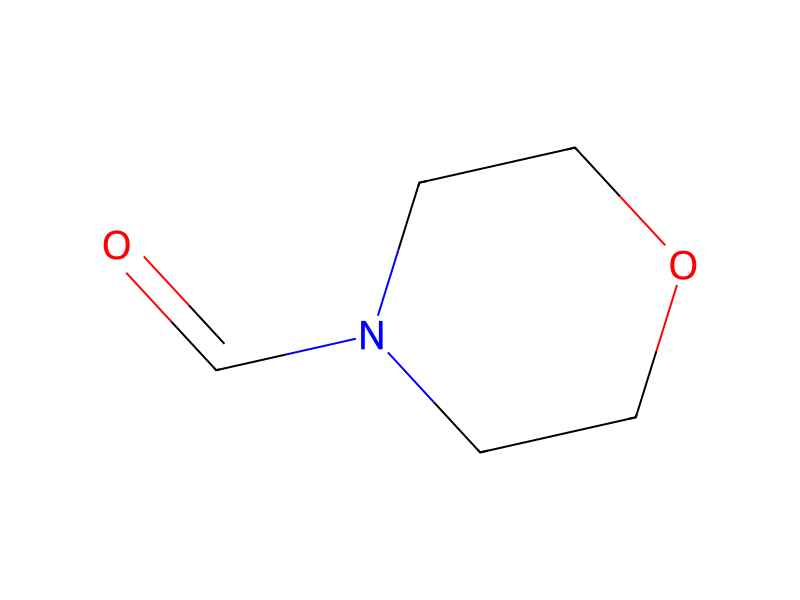
N-Formylmorpholine → HCID 9883589, compound
Reaction equation

[NH2:1][C:2]1[N:7]([CH2:8][CH2:9][CH3:10])[C:6](=[O:11])[N:5]([CH2:12][CH2:13][CH3:14])[C:4](=[O:15])[C:3]=1[N:16]=O.[CH:18]([N:20]1[CH2:25][CH2:24][O:23][CH2:22][CH2:21]1)=O.P(Cl)(Cl)(Cl)=O>C(Cl)(Cl)(Cl)Cl>[N:20]1([C:18]2[NH:16][C:3]3[C:4](=[O:15])[N:5]([CH2:12][CH2:13][CH3:14])[C:6](=[O:11])[N:7]([CH2:8][CH2:9][CH3:10])[C:2]=3[N:1]=2)[CH2:25][CH2:24][O:23][CH2:22][CH2:21]1Participants
Reactant 3


Product 1

Reagents, catalysts & solvents 1

Procedure
7.9 g (0.033 mol) of 6-amino-5-nitroso-1,3-dipropyluracil and 5.0 g (0.049 mol) of N-formylmorpholine are dissolved in 40 ml of carbon tetrachloride. At ambient temperature, 7.5 g (0.049 mol) of phosphorus oxychloride are added, the mixture is heated to reflux temperature for one hour and left to stand at ambient temperature for about 12 hours. The oil which separates off on the surface is removed, dissolved in 50 ml of dichloromethane and poured onto ice together with the remaining solution, which has been concentrated by half. After neutralisation of the aqueous phase the organic phase is separated off and the aqueous phase is extracted with dichloromethane. From the combined organic phases the title compound is obtained, after drying and evaporation, as a crystalline residue which is recrystallised from ethanol.
Workup
- temperaturethe mixture is heated
- temperatureto reflux temperature for one hour
- waitleft
- customis removed
- dissolutiondissolved in 50 ml of dichloromethane
- additionpoured onto ice together with the remaining solution, which
- concentrationhas been concentrated by half
- customAfter neutralisation of the aqueous phase the organic phase is separated off
- extractionthe aqueous phase is extracted with dichloromethane
Sources & evidence
- ORD record
- ord-dbd7969e1173441ab2163d8aeb919367
- Source dataset
- uspto-grants-1997_06
- Patent number
- US05641784
Reaction notes
Loading…